Is AI Live Translation Safe For Confidential Meetings and Events? Security and Privacy Explained
- Is AI live translation safe for confidential meetings?
- Does AI live translation record or store my audio?
- Is AI live translation GDPR compliant?
- What security questions should you ask an AI translation vendor?
- When should you avoid cloud-based AI translation?
- Final verdict: Should you use AI live translation for your next event?
- FAQ on AI Live Translation Security and Privacy
AI live translation can be secure and GDPR compliant, but it depends on the vendor and on how you run the session. Check four things before a confidential meeting:
- Where audio is processed and stored
- Whether recordings are optional
- Who can join the session
- Whether the vendor signs a GDPR data processing agreement
The sections below walk through each of these checks. They offer general guidance rather than legal advice, so for decisions specific to your event, check with your legal team.
Is AI live translation safe for confidential meetings?
Yes, for most confidential business meetings, provided the tool encrypts audio in transit, limits who can join, and lets you control what is saved.
AI live translation sends speech to cloud servers, turns it into text, translates it, and returns captions, with optional AI voice, to each listener. That data path is similar to a cloud meeting platform, so the risks are familiar: interception, uninvited listeners, stored recordings, and third parties that process the data.
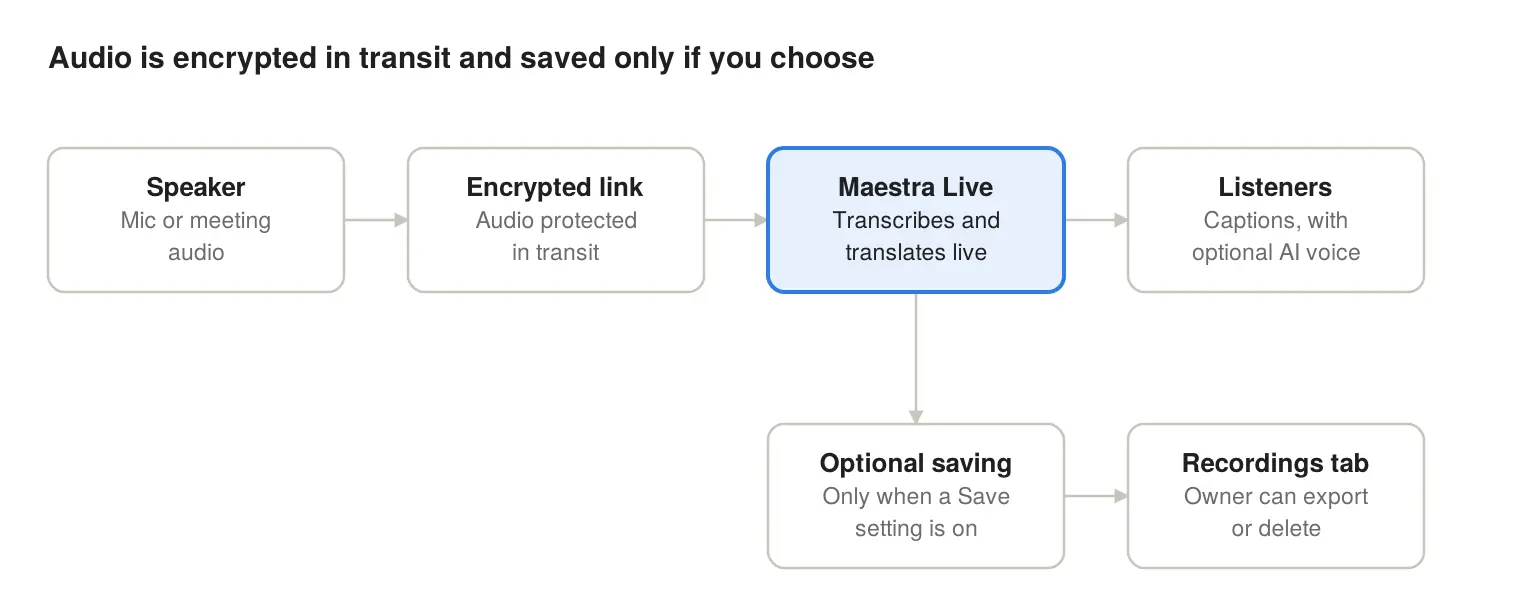
The real question is not whether AI is involved but how the vendor handles each step. A board meeting, an HR investigation and a public keynote need different settings. Public talks can use an open link. Internal meetings need a password or invite list. Highly sensitive sessions may need a private deployment, or no cloud tool at all.
In case of Maestra Live, anyone with a link can join a session. For private meetings, organizers can add a password, limit access to invited email addresses, or use both.
Does AI live translation record or store my audio?
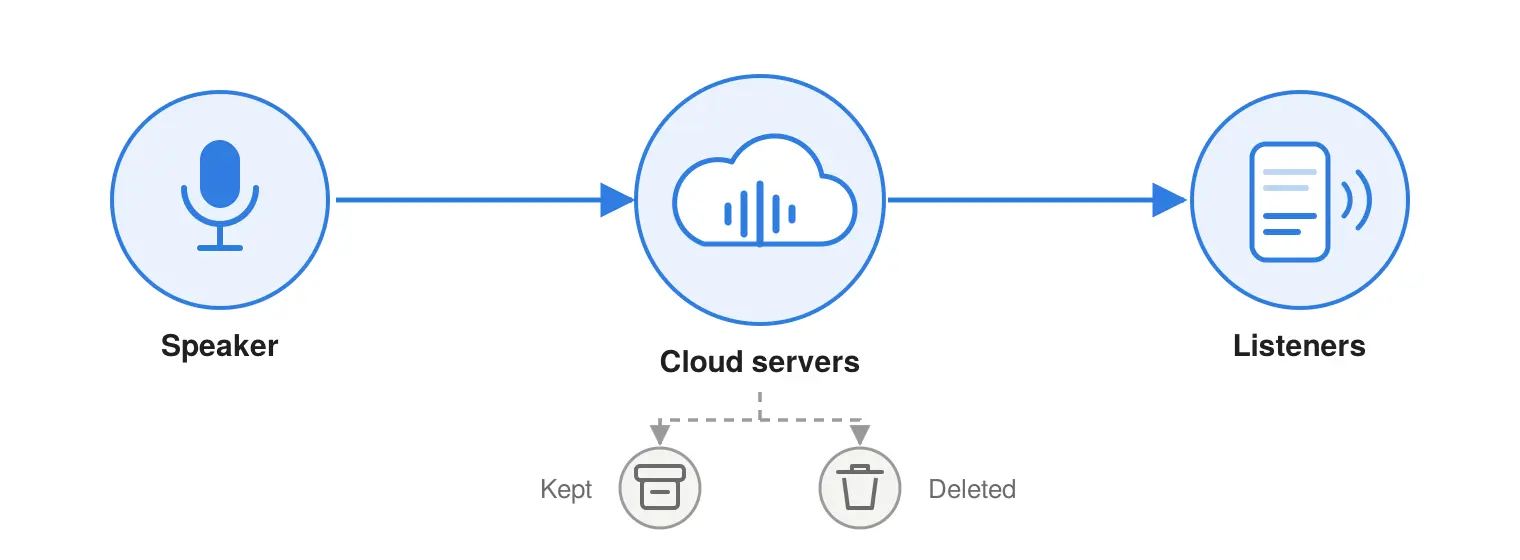
In most AI live translation tools, audio streams to cloud servers, where it is transcribed, translated and sent to listeners in seconds. Vendors differ on what they keep afterward.
🌟 Before a confidential meeting, check what is stored, where, for how long, and who can delete it.
In Maestra Live, the organizer decides what is kept. Save transcript keeps the text, and Save audio also keeps the recording. With both off, the session isn't saved when captioning stops.
Saved recordings stay in the Recordings tab, where the owner can export them or delete them at any time. If the account is closed, data is typically kept for 30 days, or deleted sooner on request. Account holders can also email Maestra’s support team to get a copy of their data or have all of it deleted.
Is AI live translation GDPR compliant?
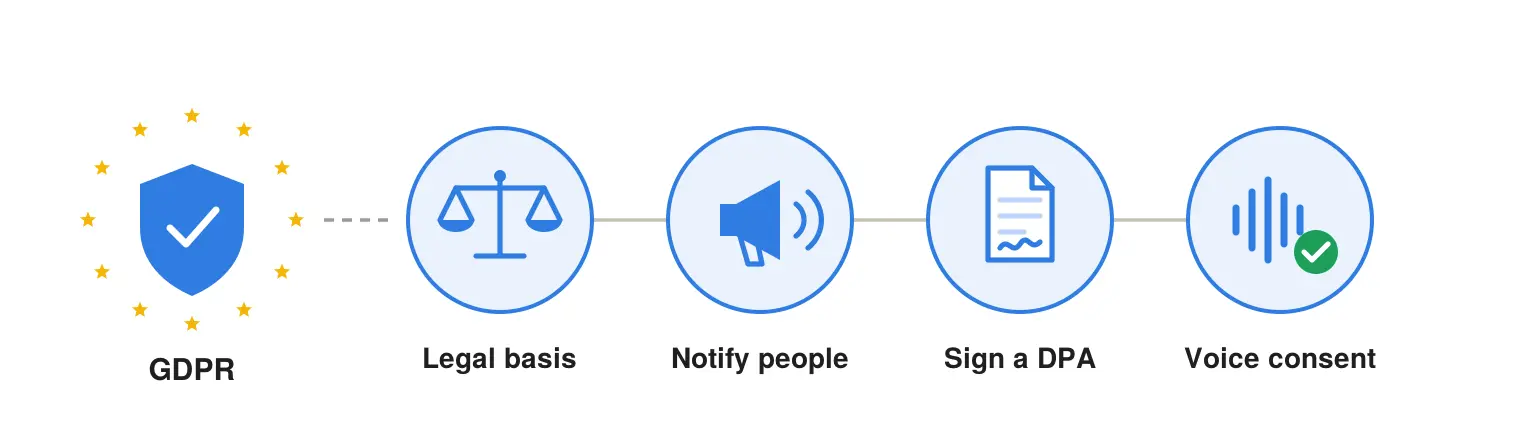
AI live translation can be used under GDPR if the organizer has a valid legal reason to process voices (such as consent or a business need), tells participants how their voice is used, and signs a data processing agreement (DPA) with the vendor. Under Article 28, that contract must cover how the vendor handles, protects and deletes your data. [1]
Voices count as personal data under GDPR. [2] If you use AI voice cloning, get each speaker's written consent first.
Recording rules are separate. Several US states, including California, Florida and Illinois, require every participant's consent before a private conversation is recorded. [3]
In Europe, GDPR requires telling participants before recording starts. If you save audio or transcripts, announce it at the start.
What security questions should you ask an AI translation vendor?
Before you book, send each vendor the same eight questions and ask for written answers. Save them in case you need them later.
🌟 Good vendors answer from published documents: a privacy policy, a security page, a DPA and help guides. Vague replies such as "we take security seriously" without specifics are a warning sign.
The table below lists each question, why it matters, and how Maestra Live answers it as of November 2026. Use it as a template for any other tool you are comparing, and add rows for your own policies, such as whether you can get a copy of your data or have it deleted on request.
If a vendor can't answer a question in writing, treat the answer as "no" until it can. For high-stakes events, ask your legal or IT team to review the DPA and the list of third parties that handle your data before signing.
| Question | Why it matters | Maestra Live |
|---|---|---|
| Is audio encrypted in transit? | Stops audio being intercepted on its way to the servers | ✅ |
| Is stored data encrypted at rest? | Protects saved recordings and transcripts | ✅ |
| Is saving optional, and can I delete recordings? | Less stored data means less to lose | ✅ (Save transcript and Save audio settings; delete from the Recordings tab) |
| Who can join a session? | Keeps out uninvited listeners | Anyone with the link by default; add a password, an email invite list, or both for extra privacy |
| Will you sign a DPA? | Required under GDPR Article 28 | ✅ (Standard DPA with EU Standard Contractual Clauses, email support@maestra.ai for a copy) |
| Where is data hosted, and by whom? | Affects transfers and data residency | United States, on AWS and Google Cloud |
| Which third parties process the data? | Each one needs the same protections | ElevenLabs for voice cloning, plus hosting and support providers |
| How long is data kept after cancellation? | GDPR storage limits | Typically 30 days after the service ends, or sooner on request |
🌟 If you're an enterprise buyer, also ask about multi-factor authentication (MFA), single sign-on (SSO) and a private instance of the tool. Maestra offers all three for enterprise customers.
When should you avoid cloud-based AI translation?
Avoid cloud AI translation when a law, contract or client policy says the audio must not leave your network or region. Common cases include legally privileged discussions, classified or defense briefings, and US health data covered by HIPAA when the vendor won't sign a business associate agreement. [4]
Data residency is another limit: if your rules require EU-only processing, a US-hosted service may not qualify.
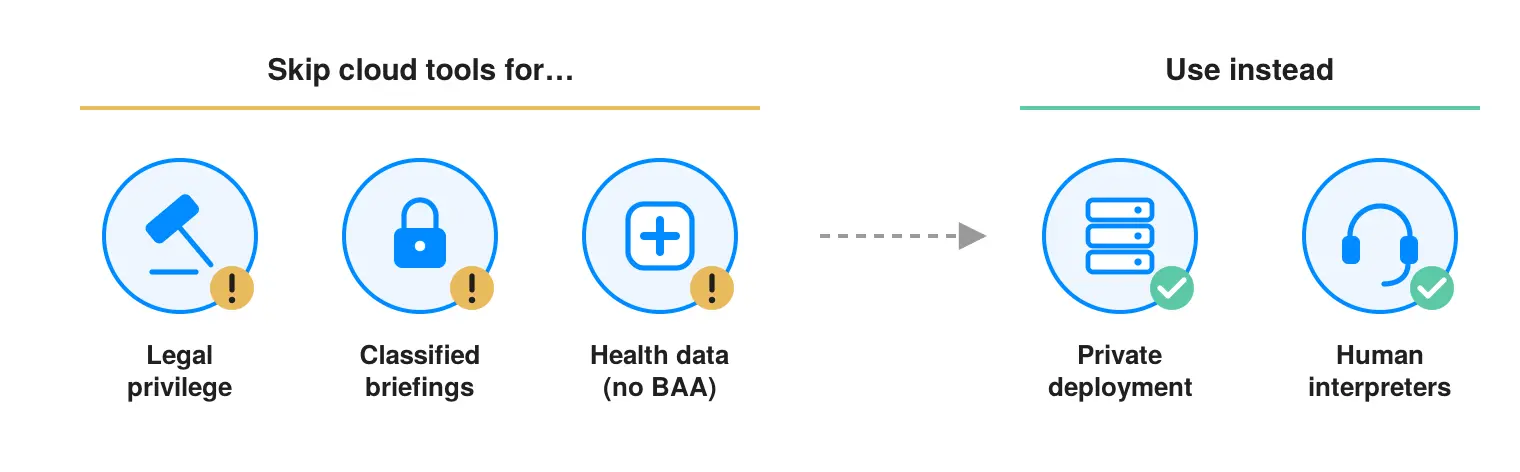
For these events, the safer options are a private deployment or certified human interpreters bound by confidentiality agreements. Maestra offers private application instances for enterprises that need higher security, so ask about one before ruling it out.
For everything else, reduce exposure: share only what the audience needs, keep saving off unless you need a record, protect the room with a password or invite list, and delete recordings once their purpose ends.
❓ Still comparing tools? Our guide to the best real-time translators for meetings compares the main options.
Final verdict: Should you use AI live translation for your next event?
Yes, AI live translation is safe for most confidential meetings and events, as long as you choose a vendor that documents its security and you set up each session with care. Most of the risks covered above are in your control: who can join, what gets saved, and which contract you sign.
Maestra Live covers these security basics: encryption in transit and at rest, optional saving, password or invite-only sessions, and a standard GDPR data processing agreement. One limit is worth knowing: data is hosted in the United States, so teams that need EU-only processing should ask about options first.
For legally privileged, classified or regulated sessions, check the contract first or use a private deployment. For everything else, use the eight questions above to check whether a vendor is ready before you book.
FAQ on AI Live Translation Security and Privacy
A DPA is the contract GDPR requires whenever a vendor processes personal data on your behalf. Live translation counts because speakers' voices are personal data. It sets out how the vendor handles, protects and deletes that data.
Not automatically. Human interpreters hear everything said, so privacy depends on the agreement they sign with you. AI tools process audio on a vendor's servers, so it depends on the vendor's contract and settings.
It can be, if speakers agree to it and you know how the voice data is handled. Voice cloning builds a model of someone's voice, so get each speaker's written consent and ask the vendor where that data is stored and how to delete it.
Cloud-based tools need an internet connection, because speech is transcribed and translated on the vendor's servers. If your event can't send audio outside your network, look for an on-premises system or book human interpreters instead.
Say it in the invitation and again at the start of the session, and explain whether anything will be saved. If you record audio or transcripts, say who can access them and how long they're kept. Clear notice builds trust and helps meet GDPR's transparency rules.
References