What Is Simultaneous Interpretation and How Does It Work?
- What is simultaneous interpretation (SI)?
- A brief history: how SI was invented
- How simultaneous interpretation actually works
- Preparation before the SI booth
- The traditional setup: booths, headsets, and ISO standards
- Remote simultaneous interpretation (RSI)
- Where simultaneous interpretation is used
- How AI is changing the field
- FAQ
Perhaps you have seen an audience member listening through a headset at a TED conference or an international press briefing before. The person in question is most likely hearing the speech in their own language, with barely a half-second delay. That is simultaneous interpretation.
As the name suggests, it is the act of interpreting speech simultaneously - in this context, the interpretation is a live translation or real-time translation.
It's one of the most cognitively demanding jobs in the world, and since 1945, it has been what holds multilingual events together.
Before everything else, let's get into the basics:
What is simultaneous interpretation (SI)?
In SI, the interpreter doesn't wait for the speaker to pause.
There's usually a two-second delay in the interpretation.
Regardless, this allows the listeners to receive the translated message through headphones - almost as if it's being spoken directly.
To further demonstrate SI, here is a concrete example:
A company is about to hold its annual general meeting in English.
Through SI, the German-speaking shareholders can listen along in German in real time.
The meeting runs at its normal pace, and only the people who need interpretation engage with it. Everyone else doesn't even notice it's happening.
This is what sets SI apart from consecutive interpretation.
CI is another type of live translation in which the speaker pauses every few sentences to let the interpreter translate.
Consecutive is honestly fine for small meetings or one-on-one settings. However, it doubles the length of any event.
Simultaneous, on the other hand, is what makes large multilingual conferences possible.
However, note that SI is also distinct from translation, which deals with written text and has the luxury of time. Interpretation is live, spoken, and unforgiving.
A brief history: how SI was invented
The technology was patented in 1926 by IBM employee Alan Gordon Finlay.
With prosecutors, defendants, and judges speaking English, French, Russian, and German, the tribunals would have taken years longer using consecutive interpretation.
The IBM system - booths, headsets, and a team of multilingual interpreters - made the trials possible in the time they took.
After Nuremberg, many of those interpreters went on to work for the newly founded United Nations, and the model spread to international institutions, courts, and large conferences worldwide.
How simultaneous interpretation actually works
At the moment of interpretation, the interpreter is doing four things at once:
- Listening to the speaker in the source language
- Analyzing meaning, tone, and intent
- Reformulating the message in the target language
- Speaking it aloud - all while the next sentence is already coming in
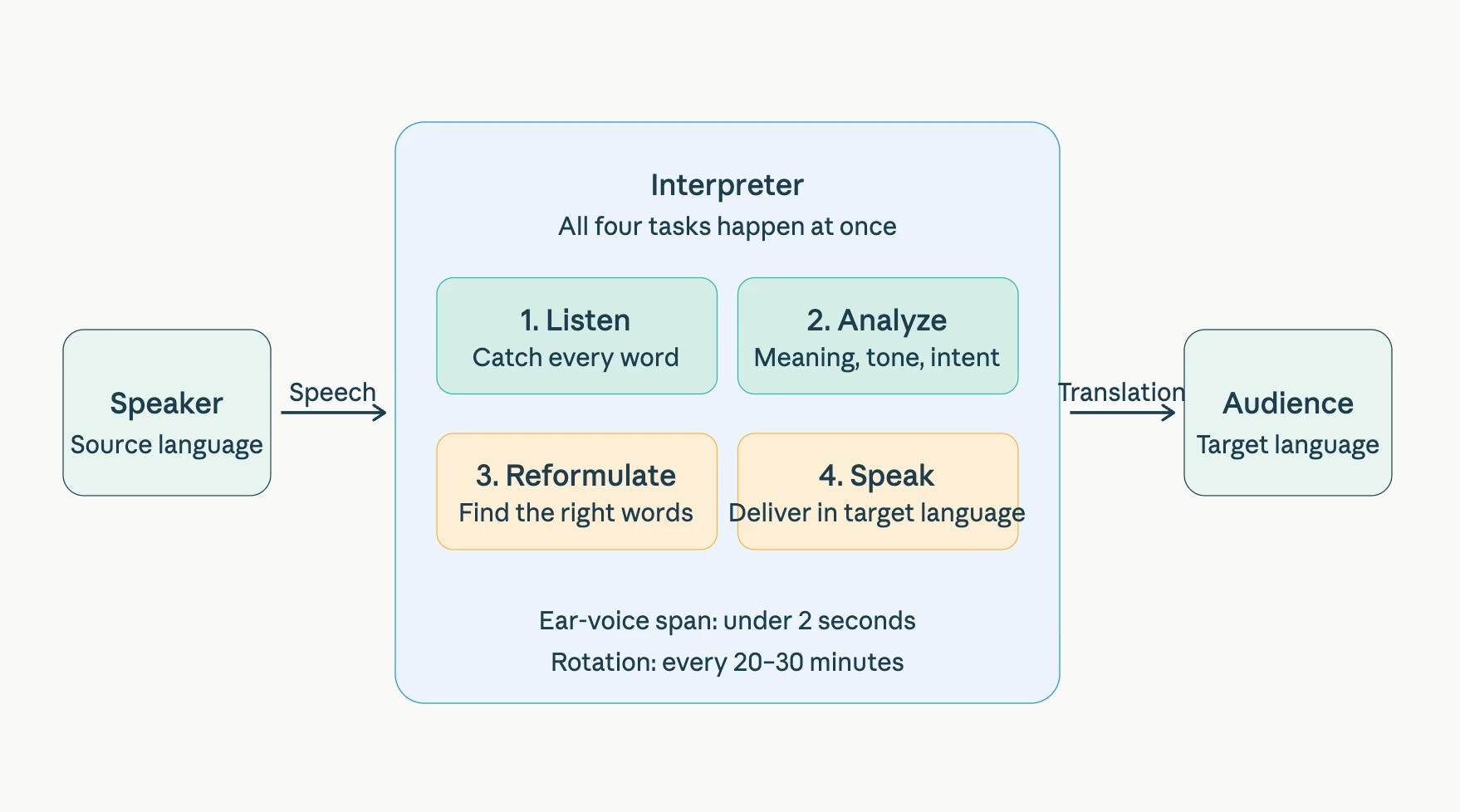
This is where the concept of ear-voice span comes in.
It's the gap between when the speaker starts a sentence and when the interpreter starts theirs.
Too short, and the interpreter risks copying the source-language grammar or tripping on false cognates.
Too long, and they forget what was said.
The cognitive load is so intense that interpreters work in pairs and rotate every 20-30 minutes.
Studies show interpretation quality drops sharply past that mark.
For a full-day conference, you're looking at two interpreters per language pair, minimum.
Experienced simultaneous interpreters typically achieve 95% accuracy or higher in their working languages, but only after years of formal training - usually a master's degree in conference interpreting, plus thousands of hours of practice.
Most professionals also specialize in specific domains - legal, medical, financial, and technical.
Because conveying terminology accurately needs real subject-matter knowledge, not just bilingual fluency.
Preparation before the SI booth
Most of a simultaneous interpreter's working time is spent on something the audience never sees: preparation.
Before the job, the interpreter studies glossaries, reviews speaker bios, reads through the agenda, and goes over any technical materials the client provides.
For a medical conference, that could mean revisiting drug names, trial methodology, and recent research.
For a financial AGM, it's earnings terminology, regulatory references, and company-specific acronyms.
This is why one of the most important things an event organizer can do is share materials in advance.
Interpreters typically only bill for the live interpretation hours, but the prep is what makes those hours look effortless.
The traditional setup: booths, headsets, and ISO standards
A standard on-site simultaneous interpretation setup looks like this:
- Soundproof booths at the back or side of the room, where two interpreters per language pair work in shifts
- Headphones and microphones for each interpreter - they listen to the speaker through one channel and speak into another
- Wireless transmitters that send each language to the audience's individual receivers
- Headsets for audience members, who select their preferred language channel
The booths themselves are regulated by ISO standards (ISO 2603 for permanent booths and ISO 4043 for mobile ones).
These standards cover dimensions, sound insulation, ventilation, and lighting.
They are all designed to give interpreters the conditions they need to focus for hours on end.
Tabletop booths exist for smaller events, but they're not fully soundproof, which makes the work harder.
There's also a less formal mode called whispered interpreting (or chuchotage). In this one, the interpreter sits next to one or two listeners and whispers the translation directly - with no equipment. This is only practical for very small audiences.
Remote simultaneous interpretation (RSI)
One of the biggest linguistic advancements this decade has been the rise of remote simultaneous interpretation - usually shortened to RSI.
Before 2020, most simultaneous interpretation happened with everyone in the same room: speakers, audience, and interpreters in their booths at the back.
Today, RSI is the default for a large share of corporate, educational, and hybrid events.
Instead of flying interpreters to a venue and renting booth equipment, RSI platforms let interpreters work from wherever they are.
The audio stream goes from the speaker to the interpreter via the cloud, to the audience's devices - all in real time.
Audience members listen through their phones, laptops, or conferencing platforms like Zoom, Teams, or Webex.
Advantages of RSI:
- No travel, lodging, or equipment rental
- Events can be organized with shorter lead times
- Organizers can book the best interpreter for the job, regardless of location
- Adding a fifth or sixth language no longer means renting more physical booths
Disadvantages of RSI
- Connectivity issues can disrupt sessions,
- Certain legal proceedings or diplomatic events may still require interpreters on-site.
For most corporate, educational, and conference use cases, RSI is now the default.
Where simultaneous interpretation is used
The classic settings are still the most visible: the United Nations, the European Parliament, international courts, and large industry conferences.
But SI shows up in plenty of other places:
- Corporate town halls for multinational companies
- Investor calls and shareholder meetings
- Live-streamed product launches and keynotes
- Webinars and virtual events with global audiences
- Academic lectures and university conferences
- Religious services in multilingual congregations
- Medical conferences and continuing education events
- Government press briefings
If a message needs to reach a multilingual audience without losing the natural flow of delivery, simultaneous interpretation services are usually the answer.
Whether booked through a language service provider, hired directly, or delivered via an AI platform.
Benefits and limitations of SI
Pros
- Real-time experience - the audience receives the message as it is delivered.
- Events run at their natural pace, instead of taking twice as long.
- Every participant follows in their preferred language.
- Less reliance on memory and notes than consecutive interpretation - interpreters work in shorter cognitive bursts.
Cons
- Interpreter fees, equipment, and (for on-site events) travel can add up quickly.
- Two interpreters per language minimum for any session over 30 minutes.
- Not ideal for two-way conversations - SI is built around a presenter-audience model, so Q&A sessions can be tricky.
- Requires preparation. Interpreters need briefing materials, glossaries, and context to perform well.
How AI is changing the field

Another recent momentum for SI and live translation is obviously the rise of AI.
Now we have AI-powered live translation software that uses speech recognition, machine translation, and text-to-speech to deliver real-time captions or audio. Usually in multiple languages & without a human interpreter in the loop.
When to use AI live translation?
Well-suited to high-volume, lower-stakes communication.
For example: weekly town halls, internal training, webinars, live streams, product demos.
It could be used when speed and scale are the priorities, and a missed nuance won't cost the business.
When to use human simultaneous interpreters?
Human interpreters remain essential for high-stakes, high-nuance work.
The cultural sensitivity, idiom handling, and split-second judgment that experienced interpreters bring are genuinely hard to automate by AI.
The correct framing isn't "AI vs human" - it's "match the method to the moment."
Some events run human interpreters for the keynote and AI captions for the breakout sessions.
Others use AI to generate live multilingual captions while a single interpreter handles the audio channel for one priority language.
The result is broader access without inflating costs.
Multilingual support becomes part of the default event setup rather than a budget line that only flagship events can afford.
FAQ
What is simultaneous interpreting, and is it the same as simultaneous interpretation
Yes.
"simultaneous interpreting" and "simultaneous interpretation" refer to the same practice. "Interpreting" describes the act, "interpretation" describes the result, but in everyday usage the two are interchangeable. Both mean rendering speech into another language in real time, while the speaker is still talking.
How long can a simultaneous interpreter work without a break?
About 20–30 minutes. The cognitive load is so intense that quality drops sharply past that mark, which is why interpreters work in pairs and rotate.
Is remote simultaneous interpretation as accurate as on-site?
For most use cases, yes - assuming a stable internet connection on all sides. Top RSI platforms now match the audio quality of in-room booths. For high-stakes legal or diplomatic settings, on-site is still preferred.
Do I need two interpreters for a short meeting?
If the meeting is under 30 minutes, one interpreter can usually cover it. For anything longer, you'll want two per language pair to maintain quality.
Can AI replace human simultaneous interpreters?
Not for high-stakes work - legal proceedings, diplomatic negotiations, or anything where idiom and nuance matter. But for webinars, internal meetings, training sessions, and live streams, AI live translation tools have become accurate and affordable enough to be a practical alternative.
What materials should I send my interpreter before an event?
Anything that helps them prepare: the agenda, speaker bios, slide decks, scripts or talking points, glossaries, and any technical or company-specific terminology. Send it as early as possible - most of an interpreter's working time is spent on prep, and the quality of the live performance depends heavily on how well they can familiarize themselves with the content beforehand.
What is whispered interpretation?
Also called chuchotage. The interpreter sits next to one or two listeners and whispers the translation directly into their ear, with no equipment. It's only practical for very small audiences.
Give Maestra's simultaneous interpretation tool a try now