Neural TTS – What Is It and How Does It Work?
- What Is Neural TTS?
- What Does TTS Stand For?
- What Is the Difference Between Neural TTS and Standard TTS?
- A Brief History of Neural TTS
- Is TTS the Same as AI?
- How Does Neural TTS Work?
- The Architectures Behind Neural TTS
- Is TTS NLP?
- Where Neural TTS Is Used
- Which Neural TTS Models Lead Today?
- A Note on Ethics
- Frequently Asked Questions
Neural TTS is the reason AI voices now sound expressive, natural, and almost indistinguishable from a real person.
But what actually changed under the hood?
And why does neural text-to-speech sound so different from the robotic systems it replaced?
This guide breaks down what it is, how it works, and where you've already been hearing it.
What Is Neural TTS?
You've probably heard neural TTS today without realizing it - the narrator on a YouTube explainer, the voice reading your audiobook, the assistant on your phone.
None of it is a real person. But none of it sounds like a robot either. At least, not for the past ten years.
Neural TTS (text-to-speech) is an AI method that converts written text into natural-sounding spoken audio.
It learns from thousands of hours of real human speech and aims to provide natural-sounding output.

What Does TTS Stand For?
TTS stands for text-to-speech.
A technology that lets computers read written content out loud.
And no, TTS is not always AI.
Older versions ran on rules and pre-recorded clips.
Neural TTS is what happens when AI is applied.
What Is the Difference Between Neural TTS and Standard TTS?
This is probably the most searched question on the topic - and for good reason. The difference in output is significant.
- Standard TTS stitches together pre-recorded audio fragments.
- Parametric TTS used mathematical models to simulate the human voice.
- Neural TTS learns directly from data.
A Brief History of Neural TTS
The problem? It generated one audio sample at a time.
At 24,000 samples per second, that's painfully slow.
What followed was a race to keep the quality and fix the speed - flow-based models, GANs.
And eventually, the non-autoregressive architectures that power most systems today.
Is TTS the Same as AI?
Not exactly - but they're connected in one way.
TTS is a technology.
While AI is what powers the modern version of it - Neural TTS
Traditional TTS works without AI. Neural TTS can't run without it.
How Does Neural TTS Work?
A neural text-to-speech system runs through three stages every time it speaks.
1 - Text Analysis
The system reads the input and figures out how to say it - not just what the words are.
It also normalizes numbers, expands abbreviations, and resolves pronunciation based on context.
("Read" as in "reed" or "red"? Context decides.)
2 - Acoustic Modeling
Here, the model converts text into a mel-spectrogram (a compact map of pitch, tone, and timing).
This is where the natural aspect is built.
3 - The Vocoder
It converts that acoustic map into an actual audio waveform.
Neural vocoders like HiFi-GAN produce output that's largely different from a real human recording.

The Architectures Behind Neural TTS
Researchers have developed several approaches to neural TTS, each with different trade-offs.
| Architecture | How It Generates | Example Models | Strength | Limitation |
| Autoregressive (AR) | One step at a time | Tacotron 2, WaveNet | High naturalness | Slow, not really "real-time" |
| Non-Autoregressive (NAR) | Full sequence in parallel | FastSpeech, FastSpeech 2 | Up to 270x faster | Slightly less expressive |
| End-to-End (E2E) | Text in, audio out - one network | VITS, NaturalSpeech | Fewer errors, cleaner output | More complex to train |
Is TTS NLP?
TTS uses NLP (natural language processing) - but goes further.
NLP helps the system understand the text: grammar, context, and meaning.
But then neural TTS takes that understanding and turns it into sound, which adds acoustic modeling and audio generation on top.
So, briefly put: no.
NLP is part of TTS, not the whole thing.
Where Neural TTS Is Used
The applications are broad and growing, but these are the most notable:
- Accessibility - screen readers and augmentative communication tools for users with visual impairments or speech disabilities (dyslexia, ADHD, hearing impairment, etc.)
- Media and content - audiobook narration, video voiceovers, AI-generated broadcast content
- Enterprise - automated customer service, consistent brand voice at scale
- Localization - dubbing and voice translation across languages without re-recording
Tools like Maestra's text-to-speech and video dubber allow content teams to generate voiceovers and dubs across 100+ languages. Without a recording studio. In a totally separate localization workflow.
Which Neural TTS Models Lead Today?
For research-grade quality, Amazon's BASE TTS sits at the top. A billion-parameter model trained on 100,000 hours of audio. It handles things smaller models can't - correct stress on compound nouns, natural question intonation, and emotional tone from context alone.
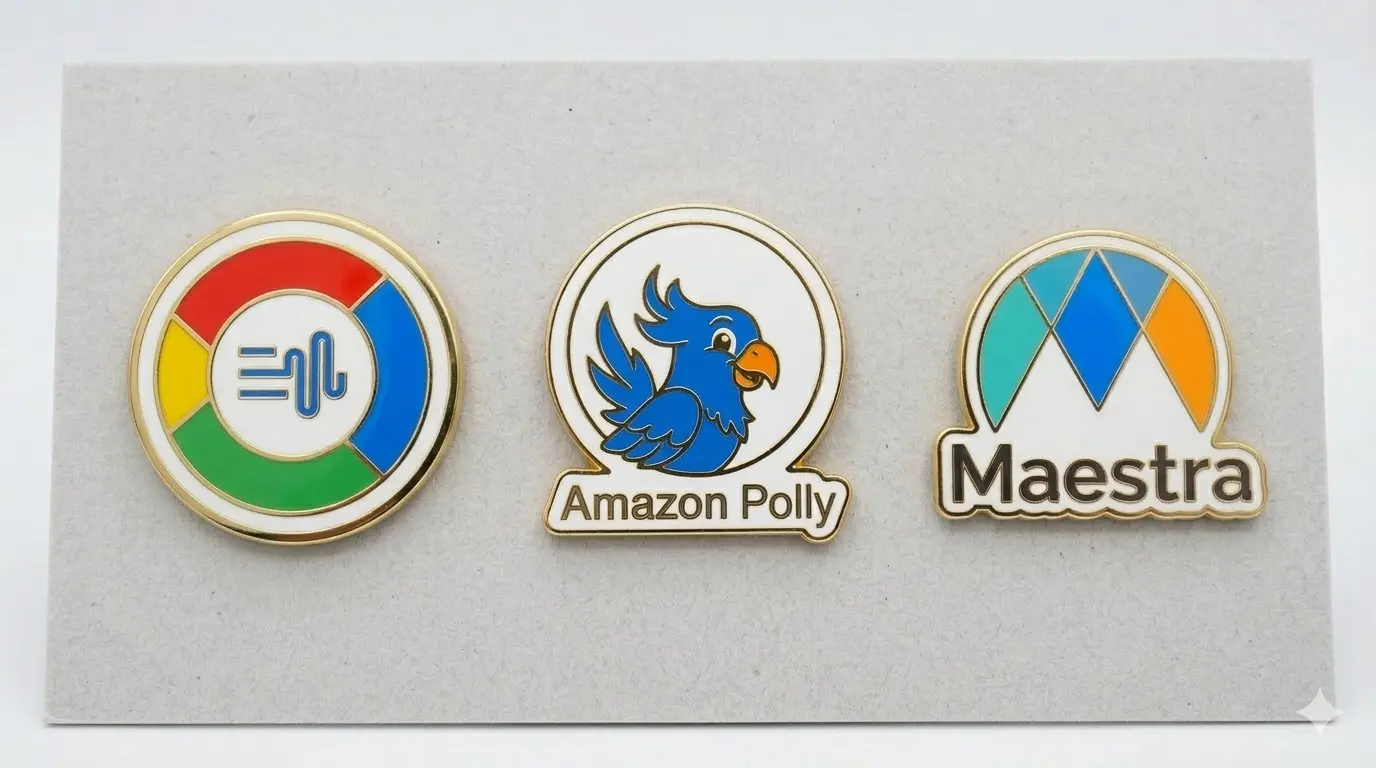
On the API and product side, three platforms dominate adoption:
- Google Cloud TTS - leads on scale and language coverage.
- Amazon Polly - integrates tightly with AWS infrastructure.
- Maestra - brings neural TTS directly into content workflows.
A Note on Ethics
Neural TTS at this level comes with real risks.
Audio deepfake technology.
Synthetic voices used to impersonate real people.
The use of TTS for fraud, identity theft, and disinformation has also risen now with AI being in the picture.
Voice cloning now works from seconds of reference audio.
The research community is working on detection tools and watermarking. Some labs, including Amazon, have chosen not to open-source their most capable models for exactly this reason.
Frequently Asked Questions
How does neural TTS handle different languages?
Most leading platforms now cover 100+ languages.
Quality varies, though. English, Spanish, and Mandarin sound the most natural - they have the most training data behind them.
Smaller languages can still sound robotic or carry an accent from the dominant training language. The gap is closing fast, but it's not gone yet.
Can neural TTS replace human voice actors?
For some use cases - yes.
Explainer videos, e-learning, audiobooks of factual content, customer service prompts. Neural TTS handles these well and cheap.
For acting, character work, or anything that needs emotional range - not yet. The expressiveness is good. It's not Oscar-winning.
Is neural TTS free?
Some tiers, yes. Most platforms offer a free trial or limited free usage.
Google Cloud TTS and Amazon Polly charge per character once you pass the free tier.
Maestra offers free TTS within the free trial, no credit card required.
For commercial use at scale - you'll pay. But for testing or short projects, free works.
What's the difference between neural TTS and voice cloning?
Neural TTS generates a generic AI voice. You pick from a library, type your text, get audio.
Voice cloning takes a specific person's voice and recreates it from a few seconds of reference audio. Same neural tech underneath, different use case.
TTS = a voice. Cloning = your voice.
12 Best Voice Cloning Software (AI-Powered, Free & Paid)