What Is Cross-Cultural Communication? A Guide for Global Teams
Working with people from different cultures is harder than it looks. The same email can read as polite to one person and cold to another. A pause in a meeting might mean someone is thinking, or it might mean they disagree and would rather not say so. Even a simple "yes" can carry a different weight depending on where the person grew up and how they were taught to communicate.
These small gaps don't usually cause big problems on their own. The trouble is that they pile up. Over a few weeks, a team can lose trust, miss deadlines, or watch a project slowly go off the rails without anyone being able to point to exactly when things started slipping.
The good news is that this isn't a personality issue or something only certain people can do well. It's a skill, and like most skills, it gets better with practice and a few clear habits.
This guide covers what cross-cultural communication is, why it matters for global team communication, the obstacles that show up most often, and the practical things you can do to handle them.
TL;DR
- Cross-cultural communication is helping people from different cultures understand each other.
- It affects results, retention, and mistakes more than most realize.
- The skill is a few habits: clarity, written decisions, and asking when in doubt.
Let's start with what cross-cultural communication actually means.
What is cross-cultural communication?
Cross-cultural communication, sometimes called intercultural communication, is what happens when people from different cultures try to understand each other through what they say, how they say it, and what they leave unsaid. It is not the same as translation. Two people can speak the same language perfectly and still miss each other's meaning, because the unwritten rules behind the words are different.

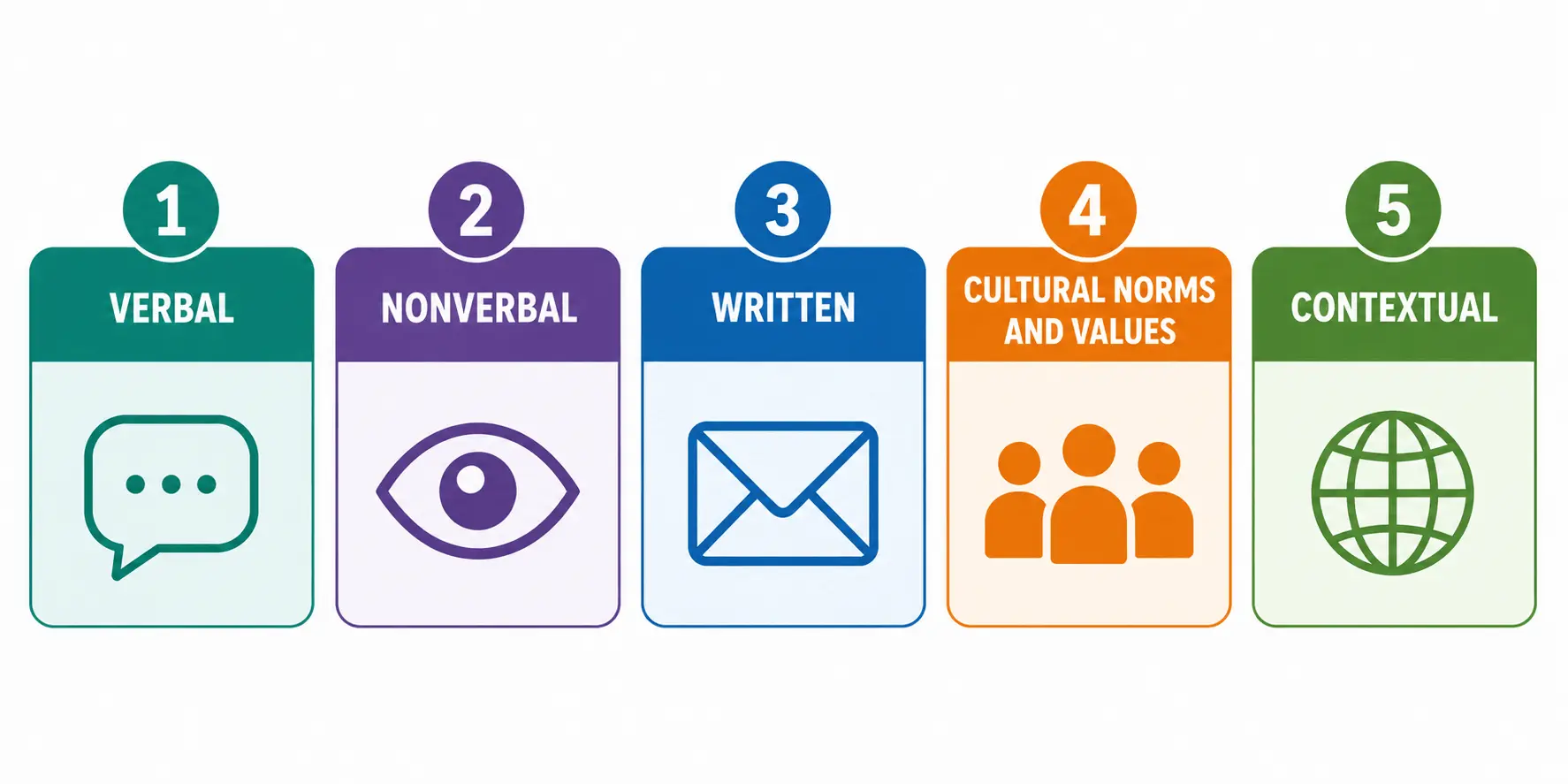
There are five crucial elements that shape cross-cultural communication:
- Verbal: The actual words, and how directly they're used. For instance, "I disagree" lands very differently in Amsterdam than in Jakarta, even when both speakers are using English.
- Nonverbal: Eye contact, gestures, posture, and silence. In some cultures a pause means someone is thinking. In others it means they disagree.
- Written: Email tone, message length, and how requests are phrased. A German colleague's "Please send the file" is not rude; it's efficient. A Brazilian colleague's three-paragraph opening is not fluff; it's how trust gets built.
- Cultural norms and values: How hierarchy, time, disagreement, and trust are treated. A consensus-driven Swedish team and a top-down French team can both be highly effective. However, a meeting that mixes them without translation between the two will feel chaotic to one side and slow to the other.
- Contextual: Cross-cultural researchers describe a spectrum from low-context to high-context cultures. Low-context cultures (the U.S., Germany, the Netherlands, Australia) value clear, direct messages: say what you mean, repeat it if needed. High-context cultures (Japan, China, Korea, and much of the Arab world) carry meaning through tone, relationship, and what is left unsaid.
A peer-reviewed study of 774 Dutch, Greek, and Japanese participants found measurable differences in how each group communicates. The Japanese group communicated most indirectly, while the Dutch relied more on explicit nonverbal signals. [1]
Neither style is better. They just ask you to listen in different ways.
Once you can see those five elements at work, the next question is the obvious one: why put the effort in? Plenty of teams operate across cultures without ever naming any of this and seem to do fine.
The honest answer is that the costs are just hidden until something breaks.
Why Effective Cross-Cultural Communication Matters a Lot
Global team communication rarely shows up as a line item on anyone's quarterly report, but its effects show up everywhere else: in deals that close or don't, in employees who stay or leave, and in campaigns that resonate or quietly fall flat. Below are three reasons it deserves more attention than it usually gets.
It Drives Real Business Results
McKinsey's Diversity Matters Even More research, drawn from 1,265 companies across 23 countries, found that firms in the top quartile for ethnic diversity on executive teams were 39% more likely to outperform their peers on profitability. [2]
Diverse teams aren't automatically better. They're better when communication is set up to let different perspectives actually come through. Without that, you get the diversity but none of the benefit.

It Shapes Trust and Retention
Trust is built or broken in small communication moments: a misread tone in Slack, a meeting that consistently runs in one cultural style, a quiet team member whose silence gets read as agreement. Companies with strong communication practices retain employees at meaningfully higher rates. The ones without it bleed talent in ways the exit interviews rarely name precisely.
It Prevents Expensive Mistakes
Cross-cultural missteps are easy to laugh at, such as the mistranslated slogan or the product name that meant something embarrassing in another language. But the funny ones that make the listicles are not the ones that hurt most. The unfunny ones (deals that quietly didn't close or partnerships that went cold) are those that cost companies the most, and they almost never get traced back to the real cause.
💡 Key takeaway: Cross-cultural communication shapes the parts of a business that matter most (profitability, retention, and the deals that get done) but its impact is usually invisible until something goes wrong. Treat it as a core skill instead of a soft one.
The Biggest Barriers to Cross-Cultural Communication
Before getting into how to improve cross-cultural communication in the workplace, it's worth looking at the obstacles first. Once you know what to watch for, most of the problems are easier to prevent than to fix.
Language Gaps (Even with a Shared Language)
Most international teams now operate in English, but a non-native speaker in a fast-moving meeting is doing two jobs at once: following the language and following the actual content. Idioms and expressions can especially be challenging.
One solution might be using a real-time translator with a custom dictionary, so the words your team uses every day (product names, technical terms, internal acronyms) get translated the right way instead of coming out wrong.
Translate Meetings in Real Time in 125+ Languages
High-Context vs. Low-Context Misreads
Some of the biggest cultural differences on global teams come down to how directly people communicate. A direct American "this won't work" can feel rude to a Japanese colleague. A Japanese "we will think about it carefully" can feel evasive to the American.
The fix isn't picking which style is right. It's making the different cultural backgrounds visible, so the team can name them out loud instead of guessing what each other really meant.

Nonverbal Cues That Don't Translate
Silence, eye contact, head movements, and even smiles all carry different meanings in different cultures. On video calls, where body language is already harder to read, the room for misreading is wider than people realize.
Time Zones and Async Friction
A team spread across San Francisco, London, and Singapore has only about three hours of overlap on a good day. When live meetings stay the default, someone is always waking up early or staying up late. Over time, that cost tends to fall on the same regions again and again. People in those regions burn out faster, speak up less in meetings they're tired during, and slowly disengage.

Stereotyping and Snap Judgments
Cultural awareness is useful. Cultural stereotyping is not. "The Germans will be blunt, the Japanese will be polite" might be a useful general pattern, but it doesn't tell you anything about the actual person you're working with. The best cross-cultural communicators hold these generalizations loosely and update them as they get to know individuals.
Different Feedback Styles
Few things go wrong faster in cross-cultural exchanges than feedback. Some cultures give it directly and bluntly. Others soften it so much that the criticism is almost hidden. Mix the two without warning and the direct feedback feels harsh, while the indirect feedback never lands. Both sides walk away thinking the conversation went fine, until the work shows otherwise.
💡 Key takeaway: None of these barriers are unfixable. They just need a handful of habits to manage, and most teams can start using them right away.
How to Foster Cross-Cultural Communication Skills
Start small. Pick two or three habits, make them stick, then add more later to build cultural competency.
Build Cultural Literacy
Cultural literacy is more than knowing which fork to use at a Japanese dinner. It's understanding how the people on your team actually communicate, what feels normal to them, and what might land the wrong way without anyone meaning it to.
- Watch how your teammates communicate with each other. The way colleagues from the same culture talk among themselves often shows you the defaults you'd otherwise miss.
- Notice what's not being said. In high-context cultures, the meaning is often in the pause, the tone, or the topic that gets quietly dropped. Pay attention to those moments.
- Ask, don't guess. When something feels off, follow up privately. "I noticed you went quiet in the meeting; was something off?" beats guessing for a week.

Choose Clarity Over Cleverness
In teams with different cultural groups, the simplest version of what you're trying to say is almost always the right one. Wordplay and clever phrasing tend to confuse more than they impress.
- Avoid idioms and slang. They're the easiest source of confusion in mixed-language meetings. "Let's circle back" is clearer as "let's discuss this later."
- Define acronyms in an onboarding document. What's obvious to your team at HQ might be confusing to a new hire in another office.
- Read your message back as if you didn't write it. Before sending a long email or Slack message, skim it once with fresh eyes. Anything that needs context or explanation should be rewritten.
Adapt Your Style, Don't Abandon It
A British manager doesn't need to become Japanese to work well with a Tokyo team. The goal is to become more flexible, not to fake.
- Match the pace of the room. If your colleagues take longer pauses before responding, slow down too. Filling silence with more words usually makes things worse, not better.
- Mirror the channel, not just the content. If a teammate prefers written follow-ups after calls, send them. If another prefers a quick voice note, do that. Small choices like these signal respect.
- Pay attention to the formality level. If your teammates address each other formally, do the same until invited otherwise. If the team is on first-name terms with the CEO, jumping in with "Dear Sir" may create distance instead of respect.

Design Meetings for Everyone (Not Just the Loudest)
The default meeting style usually works for the dominant culture and quietly excludes everyone else. A few small changes might shift that.
- Send agendas and pre-reads a day ahead. Non-native speakers can prepare what they want to say instead of thinking on their feet in a second language.
- Rotate meeting times across regions. The same teammates shouldn't always be the ones taking the 11 PM call.
- Record meetings and share the transcript. Teammates in distant time zones can catch up on their own schedule instead of trying to piece together what happened from a thread of Slack messages.
💡 Get more out of every transcript. Check out our blog on 10 ways to repurpose your meeting transcription to see how one transcript can become summaries, notes, content, and more.
Document Decisions In Writing
Verbal decisions get remembered differently across cultures, time zones, and language fluency levels. A short written summary fixes most of that.
- End every meeting with a decision log. What was decided, who owns what, by when. Five minutes of writing saves hours of back-and-forth later.
- Post it where everyone can find it. A shared document or channel works better than email threads that disappear after a few days.
- Confirm in writing after important conversations. This can prevent most cross-cultural misreads before they turn into bigger problems.
Use the Right Tools
Some of what slows global team communication down is the work itself. Some of it is just language. The right tools remove the language barrier so the team can focus on the work.
- Add real-time translation to meetings. Tools like Maestra's live voice translatorlive voice translator and AI interpreter let people follow the meeting in their own language, so no one has to fall behind while they translate in their head.
- Share a transcript after every meeting. People who missed something can read it back later. Non-native speakers especially benefit from being able to review tricky parts on their own time.
- Keep a shared glossary for the team. Put internal terms, acronyms, and product names in one place everyone can search. New hires and non-native speakers shouldn't have to ask twice.
💡 Looking for the right tool? Real-time translation can change how a multilingual meeting actually goes. We compared the top options in our guide to best real-time translators for meetings.
Make It Safe to Ask
The most useful cross-cultural skill is being able to say "I didn't follow that; can you say it again?" Teams where this is normal do better than teams where it feels embarrassing.
- Let the leaders go first. When the most senior person admits they didn't catch something, everyone else feels free to do the same.
- Treat questions as a good thing. A welcoming response keeps the habit alive. A dismissive one ends it almost immediately.
- Normalize asking in writing too. Some people are more comfortable asking in a Slack DM or an email than in a live meeting. Make it clear both channels are fine.
These habits take real effort to keep going. Most teams get them right by seeing what works elsewhere and applying the practices that fit.
Cross-Cultural Communication Examples
Here are two cross-cultural communication examples that show how the skill shapes real outcomes, both when teams get it right and when they don't.
When Different Backgrounds Become an Advantage
Research from Harvard's Program on Negotiation shows something useful about how cross-cultural communication actually plays out. In a study published in the Journal of Applied Psychology, researchers compared American and Chinese negotiators in a simulation. Pairs from different cultures generally had lower-quality conversations and reached worse outcomes than pairs from the same culture. [3] So far, no surprise.

The interesting part came from the small group of cross-cultural pairs who managed to solve their misunderstandings. Once the language and culture issues were out of the way, the differences between the two sides actually helped them. Each person brought a different way of seeing the problem, and the mix led to better ideas than either side could have come up with alone.
💡 Key takeaway: When teams put in the work to close the gap, the differences between people stop being a barrier and start being an advantage.
When Miscommunication Quietly Sinks a Project
A 2025 study published in the World Journal of Advanced Research and Reviews surveyed global teams on what actually causes their projects to fail. 44% of respondents named miscommunication as a leading cause of project failure. [4] That's nearly half of all teams losing work to a problem that has nothing to do with the work itself.
The study went further. Even small misreads, like an unclear instruction or a piece of feedback that didn't translate well across cultures, could snowball into delays, rework, and lost productivity. The researchers also found that 35% of teams with strong cross-cultural communication outperformed less diverse competitors.
💡 Key takeaway: Project failures rarely have one cause, but communication shows up in almost all of them. Make sure your team can actually understand each other before worrying about anything else.
Conduct background research on your counterpart’s culture, but spend even more time getting to know her as an individual.
Conclusion
Cross-cultural communication is one of those things that sounds optional until you watch it go wrong. A missed signal here, a misread tone there, and a project that should have worked starts losing time it can't get back. None of it is dramatic in the moment. That's part of what makes it so easy to ignore.
Here is what teams that handle this well actually do:
- They write decisions down. A meeting summary saves hours of confusion later, especially across time zones and language gaps.
- They build cultural awareness into the team's habits. Knowing how teammates prefer to give feedback or run meetings is more useful than any cultural training video.
- They keep language plain. Clever phrasing might sound good in your head, but it has a risk of leaving non-native speakers behind.
If you take one thing from this guide, let it be this. Don't try to fix everything at once. Pick two habits that fit how your team already works. Stick with them for a month and see what changes. Most teams find the next month easier than the last, and the one after that easier still.
A real-time translator handles a surprising amount of this on its own. When everyone can follow a meeting in their own language, the gap between native and non-native speakers stops showing up in who contributes and who stays quiet. That's why tools like Maestra's live voice translator are worth trying early, before you redesign anything else.
Frequently Asked Questions
What are the main types of cross-cultural communication?
Most frameworks group them into verbal, nonverbal, written, and contextual, with a fifth layer of values and norms (hierarchy, time, feedback) sitting underneath all four. Edward Hall's high-context vs. low-context distinction is the most widely cited contextual model. Meanwhile, Erin Meyer's eight-dimension culture map is the most used in business settings.
What's the difference between cross-cultural and intercultural communication?
The terms are used almost interchangeably in practice. Academically, cross-cultural tends to compare cultures from the outside (how Japanese and German communication styles differ in general), while intercultural focuses on what happens when people from those cultures actually interact (what happens when a specific Japanese and German colleague work together). For most working teams, the distinction is fine to ignore.
How can I promote cross-cultural understanding in my team?
The teams that get this right usually treat intercultural communication as part of the work, not an extra thing to do on top of it. That means noticing when someone goes quiet in a meeting and following up later, asking a teammate why they handled something a certain way instead of guessing, and being open about your own cultural values when you realize they've been guiding your decisions. Over time, these small moments do more than any workshop can.
What are the best communication strategies for cross-cultural teams?
The strategies that actually work are simple and consistent. Default to plain language, document decisions in writing, and design meetings considering people who aren't in the dominant cultural context. Add live meeting translation, shared glossaries, and rotating meeting times so the same teammates aren't always the ones adjusting.
How can I handle language barriers in multilingual meetings?
The most useful thing you can do is plan for language differences instead of pretending they don't exist. Send agendas a day ahead so non-native speakers have time to prepare, keep idioms and slang out of the conversation, and translate speech in real time so everyone can follow along in their own language. Following up with a written summary afterward catches anything that got lost in real time.
References