Google Meet Real-Time Speech Translation Guide + Alternative
- TL;DR
- Google Meet Real-Time Speech Translation: Availability & Supported Languages
- How does Google Meet translation work?
- Benefits & Limitations of Google Meet Live Translation
- A Guide to Maestra's Real-Time Speech Translator
- Real-Time Online Voice Translation: Google Meet vs. Maestra
- Top Use Cases for Real-Time Speech Translation
- Final Verdict
- FAQs on Google Meet Real-Time Speech Translation
Recently, I’ve been experimenting with Google Meet’s real-time speech translation feature and how it performs in multilingual meetings. While it’s one of the more interesting developments in AI-powered communication, I think the version most people can use today is still fairly limited in terms of supported languages and customization options.
Those limitations can become noticeable fairly quickly if you or your team regularly work with participants who speak different languages or rely on platforms outside of Google Meet. In those cases, it can be useful to look at other tools that offer broader language support or more flexible setups.
TL;DR
In this blog, we'll:
- Take a look at Google Meet's real-time speech translation feature (including its pros, cons, and how it works)
- Explore Maestra's live speech translator (including its key features and how to use it step by step)
- Compare Google Meet and Maestra side by side
- Highlight the use cases where AI-powered live voice translation delivers the most value
Let's get started.
Google Meet Real-Time Speech Translation: Availability & Supported Languages
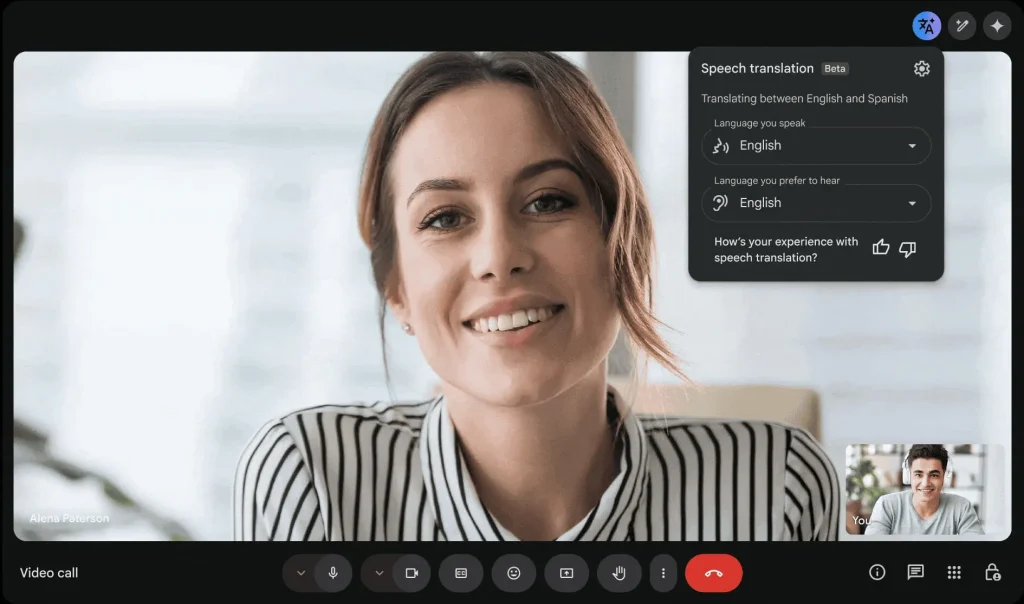
For years, Google Meet has offered live captions, allowing users to see a text transcription of what's being said. While helpful, it still required the participants to read and process the information. The real-time speech translation feature takes things significantly further by automatically translating the speaker's voice into the chosen target language in real time. [1]
Powered by Google's Gemini AI, the system not only translates the words but also preserves the speaker's original tone, pitch, and vocal style. This creates a natural meeting translation experience; for instance, allowing a manager speaking in English to be heard in Spanish by their Madrid-based colleagues without any need for a human interpreter.
Who can use AI speech translation in Google Meet?
Initially launched as a limited beta, the feature reached general availability in early 2026.
As of March 2026, Google Meet live speech translation is a premium feature available to the following subscribers:
- Individual users: Google AI Pro and Google AI Ultra subscribers.
- Business and education: Google Workspace customers on Business Standard and Plus, Enterprise Standard and Plus, Frontline Plus, and users with Gemini AI for Business or Education add-ons.
Only one participant (typically the host) needs an eligible subscription to enable the feature for the entire meeting. Once enabled, all participants can choose to listen to the translated audio.
❓ Are you a Gemini user wondering can Gemini translate in real time? Our blog explains what it can and can't do.
Which languages does Google Meet support for real-time speech translation?
Google Meet live translation expanded beyond its initial English-Spanish pairing to a core group of major global languages. The version that is generally available today supports bidirectional real-time translation between English and five major languages:
- English↔Spanish
- English↔French
- English↔German
- English↔Portuguese
- English↔Italian
This is set to change significantly. In June 2026, Google announced Gemini 3.5 Live Translate, a new speech-to-speech model that expands Meet's coverage to 70+ languages and over 2,000 language combinations in a single meeting, removing the previous restriction of only translating to and from English. [2]
As of this writing, the upgrade is rolling out in private preview for select Google Workspace customers, with a broader rollout planned for later in 2026. Pricing and the eligible Workspace tiers for the expanded feature have not yet been announced.
How does Google Meet translation work?
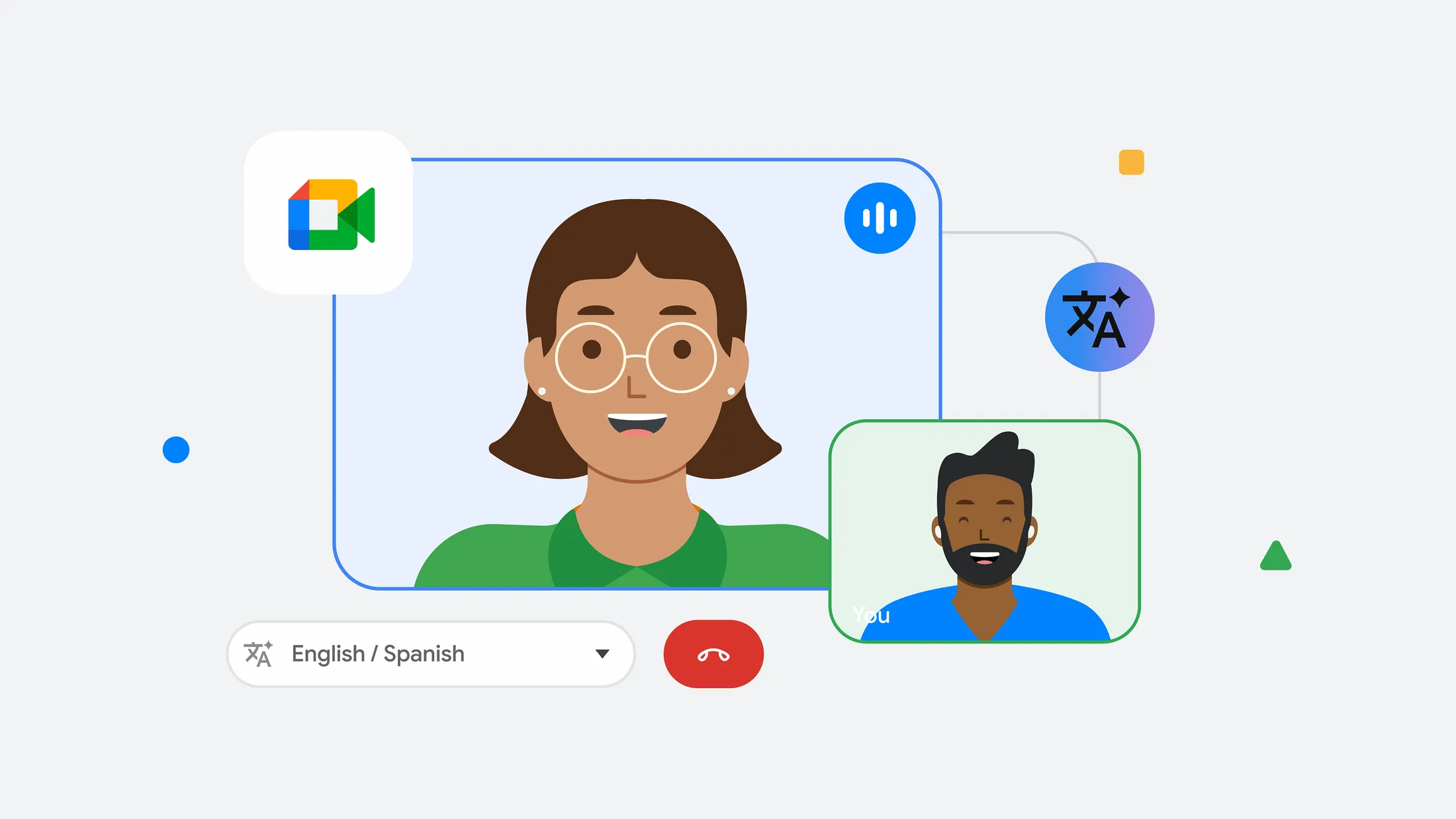
Setting up Google Meet translation is a two-part process: a subscriber must first enable it for the meeting, and then each participant must configure their own listening and speaking preferences.
How to Enable AI Speech Translation in Google Meet (Hosts/Subscribers)
If you have an eligible subscription, you can turn on translation for everyone in the call:
- Join the meeting on a computer (mobile support for Google Meet real-time speech translation is expected to come later in 2026).
- Click Meeting tools>Speech translation at the bottom right.
- Click Enable translation for everyone.
❗Important: Only the subscriber/host has the authority to change the language combination for the entire meeting.
How to Configure AI Speech Translation in Google Meet (All Participants)
Once the feature is active, each person can customize their experience:
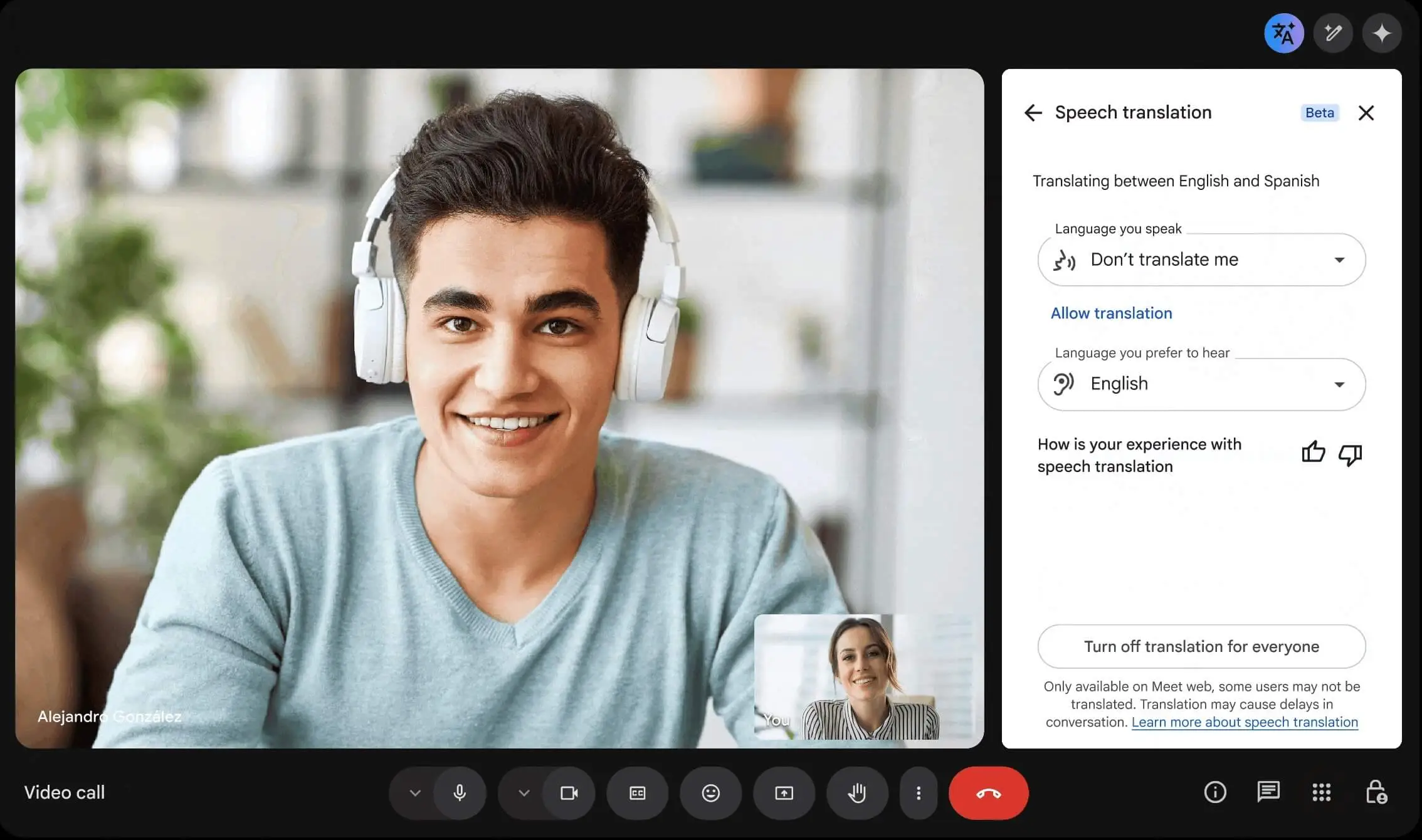
- Click the speech translation badge (a blue icon) in the top right corner of the screen.
- Select the Language that you speak and Language that you prefer to hear. (For the best experience, Google recommends setting both of these to your native language.)
- To allow your voice to be translated, you must click Allow translation>Translate me under Language that you speak. (To protect your privacy, Google will not translate your voice for others until you explicitly grant this permission.)
- Once configured, the AI will begin dubbing other speakers for you in real time. You will hear the translated version clearly while the original speaker’s voice plays quietly in the background. This helps you follow the conversation while still hearing the speaker's real tone and emotion.
For changing language combinations or more information, you can visit Google Meet's official speech translation guide.
Speech translation is designed to make meetings more inclusive and effective.
Benefits & Limitations of Google Meet Live Translation
AI speech translation in Google Meet can significantly improve communication in multilingual meetings. However, like any AI-powered system, it also comes with certain limitations depending on language support, meeting conditions, and subscription access.
Benefits of Google Meet Translation
- Natural "dubbed" experience: Unlike traditional text captions that require you to look away from the speaker, this feature lets you maintain eye contact while hearing a voice that mimics the speaker’s original tone and vocal style.
- Unified Workspace integration: There is no need for third-party bots or external plugins. The translation happens natively within the Meet interface, maintaining Google’s enterprise-grade security and encryption.
- Cost-effective solution: Since the feature is built directly into eligible Google Workspace and Google AI plans, teams can add translation capabilities without getting separate interpretation services or tools.
- Easy meeting-wide activation: A subscriber can enable translation for all participants with a single toggle. Once active, a blue badge appears for everyone, ensuring the entire team is aware that translation is available and ready to use.
Limitations of Google Meet Translation
- Single language pair in the widely available version: For now, the broadly available feature can only have one translation pair (e.g., English↔Spanish) active in a meeting at a time. The new Gemini 3.5 Live Translate model introduces 2,000+ language combinations in a single meeting, but it is still in private preview and not yet available to most users.
- Limited number of supported languages today: The generally available feature is primarily focused on bidirectional translation between English and five major languages: Spanish, French, German, Portuguese, and Italian. The 70+ language expansion via Gemini 3.5 Live Translate has been announced but remains gated behind private preview, with no confirmed general availability date, pricing, or tier requirements.
- Processing delay: While designed for "near real-time" translation, there can be an inherent delay in the process. This pause, typically a few seconds, is necessary for the system to capture the audio, process it, translate it, and then synthesize the new speech.
- Device restrictions: Google Meet live speech translation is currently optimized for desktop use. While a rollout for Android and iOS apps is underway, it is still a disadvantage for users who primarily join meetings from mobile devices.
- No recording support: Translated audio is not currently captured in Google Meet recordings. If you record a meeting, the saved video file will only contain the original spoken audio, not the AI-dubbed translations.
- Limited independent verification: Google's quality and voice-preservation claims for the new model come from its own materials, and independent benchmarks are not yet available. Google itself notes that voice replication can become inconsistent during long or multi-speaker sessions, and that language detection may struggle with strong accents or rapid language switching.
Translate Speech in Real Time
10 Best Real-Time Translators for Meetings
A Guide to Maestra's Real-Time Speech Translator
Google Meet real-time speech translation is a great step forward, but from what I've seen, many individuals and teams still need something more flexible, like a dedicated AI interpreter.
I started using Maestra’s speech translator when I needed something that could handle more languages and work across different platforms without being tied to a single meeting tool. In this part, I'll walk through the features that stand out and show how to start using the tool step by step.
Key Features of Maestra's AI Speech Translator
Below are the key features of Maestra's real-time online voice translator, which provides both live speech translation and translated captions to support multilingual communication:
- 125+ supported languages: Maestra supports 125+ languages for real-time speech translation, more than the core set available in Google Meet's standard version, enabling inclusive communication across nearly any language group.
- Multiple source and target languages: Users can select multiple source and target languages in the same session. This allows every speaker and listener to communicate in their preferred language without being limited to a single language pair.
- Automatic language detection: The tool can automatically detect the language a speaker is using without requiring manual selection. This allows conversations to flow naturally even when participants switch languages during the session.
- Speaker detection: The system can automatically identify and separate different speakers during a session. This helps participants follow the conversation more easily and clearly shows who is speaking in translated captions.
- Contextual translation: Users can add and save context (background and domain information) to help the system better understand the topic of the conversation. This improves translation accuracy and provides greater terminology consistency throughout the session.
- Automatic voice cloning: The live voice translator can preserve the speaker's original voice through AI-powered voice cloning. This allows the translated speech to retain the speaker’s tone, pitch, and vocal characteristics, creating a more natural listening experience.
- AI voices: Translated speech can also be delivered using natural-sounding AI voices. More than 800 voices are available in a variety of tones and accents to match the audience's preferences.
- Customizable live captions: The tool also generates live translated captions that can be customized for readability and accessibility. Users can adjust elements like caption style, size, and display to make conversations easier to follow in real time.
- Transcript saving and AI enhancements: Every live translation and transcript can be saved to your dashboard for later access and editing. From there, you can use built-in AI features to generate summaries, extract keywords, perform sentiment analysis, and gain deeper insights from the conversation.
- Shareable sessions: Each translation session can be shared with participants through an invitation email. Attendees simply join the session from their own device and receive translated speech and captions in their selected language.
- Integrations: Users can integrate the live translator with platforms like Zoom, Microsoft Teams, OBS, or vMix. This makes it possible to add real-time speech translation to meetings, webinars, broadcasts, and live streams without changing their existing setup.
How to Use Maestra's Live Speech Translator
Now let's walk through how to use Maestra's real-time speech translator:
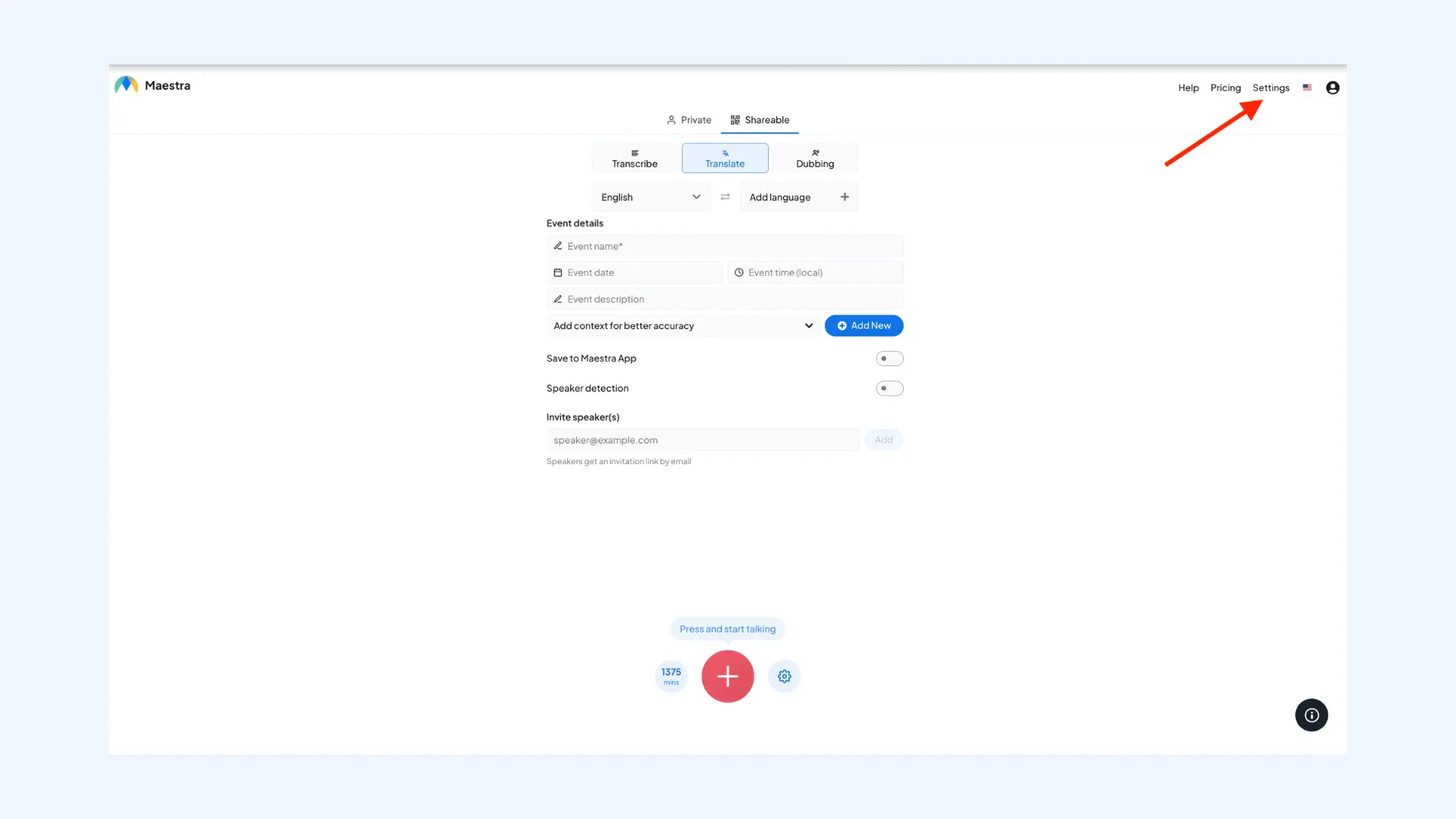
- Go to the live translator and log in to your account. From the top, choose either Private or Shareable mode. (In this walkthrough, we’ll focus on the shareable option, but if you select private, you only need to follow the first four steps before starting your session.)
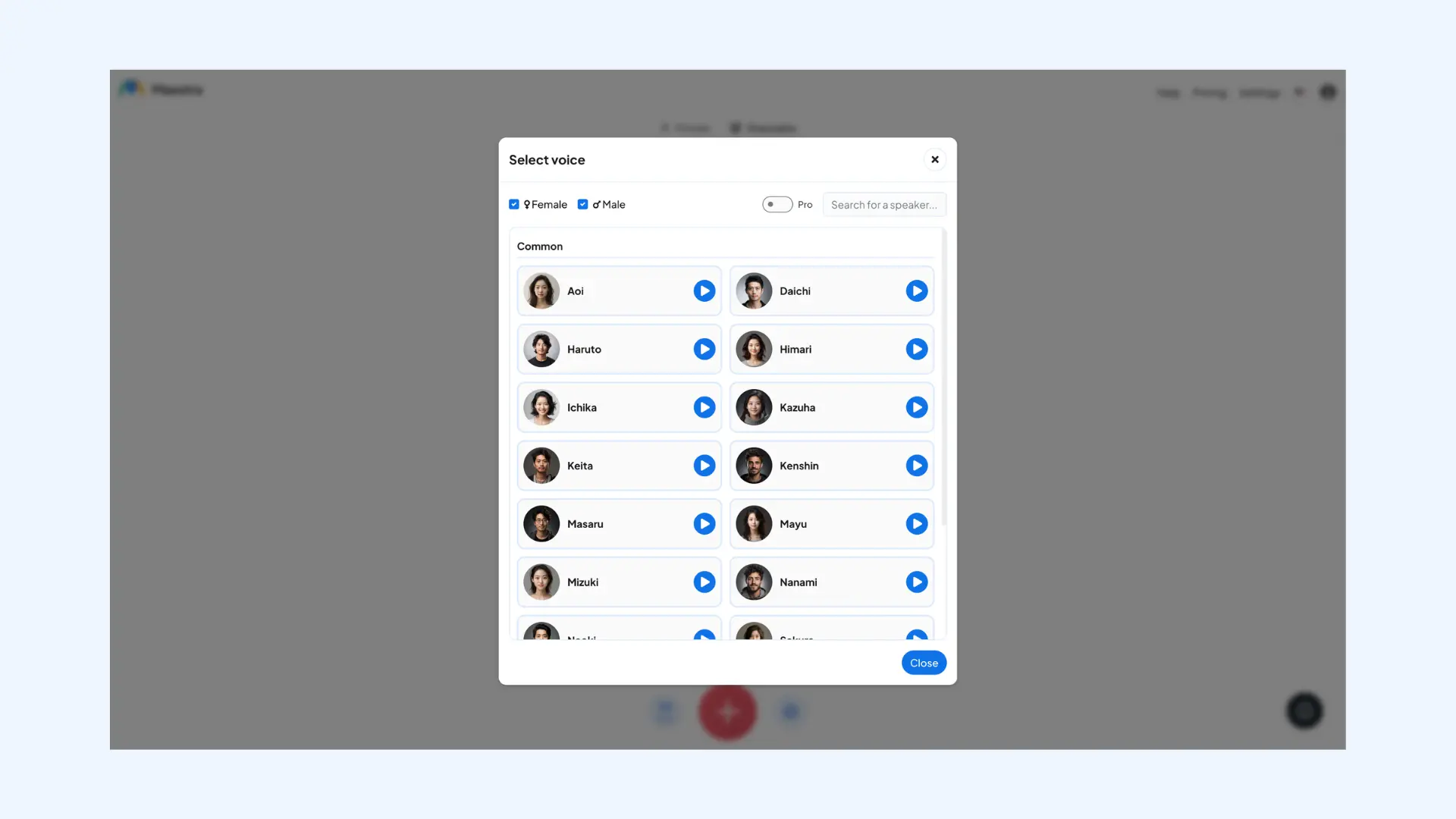
- Click Dubbing from the upper menu.
- Select speaker and translation languages. You can choose multiple languages for each, or enable auto-detect for the spoken language.
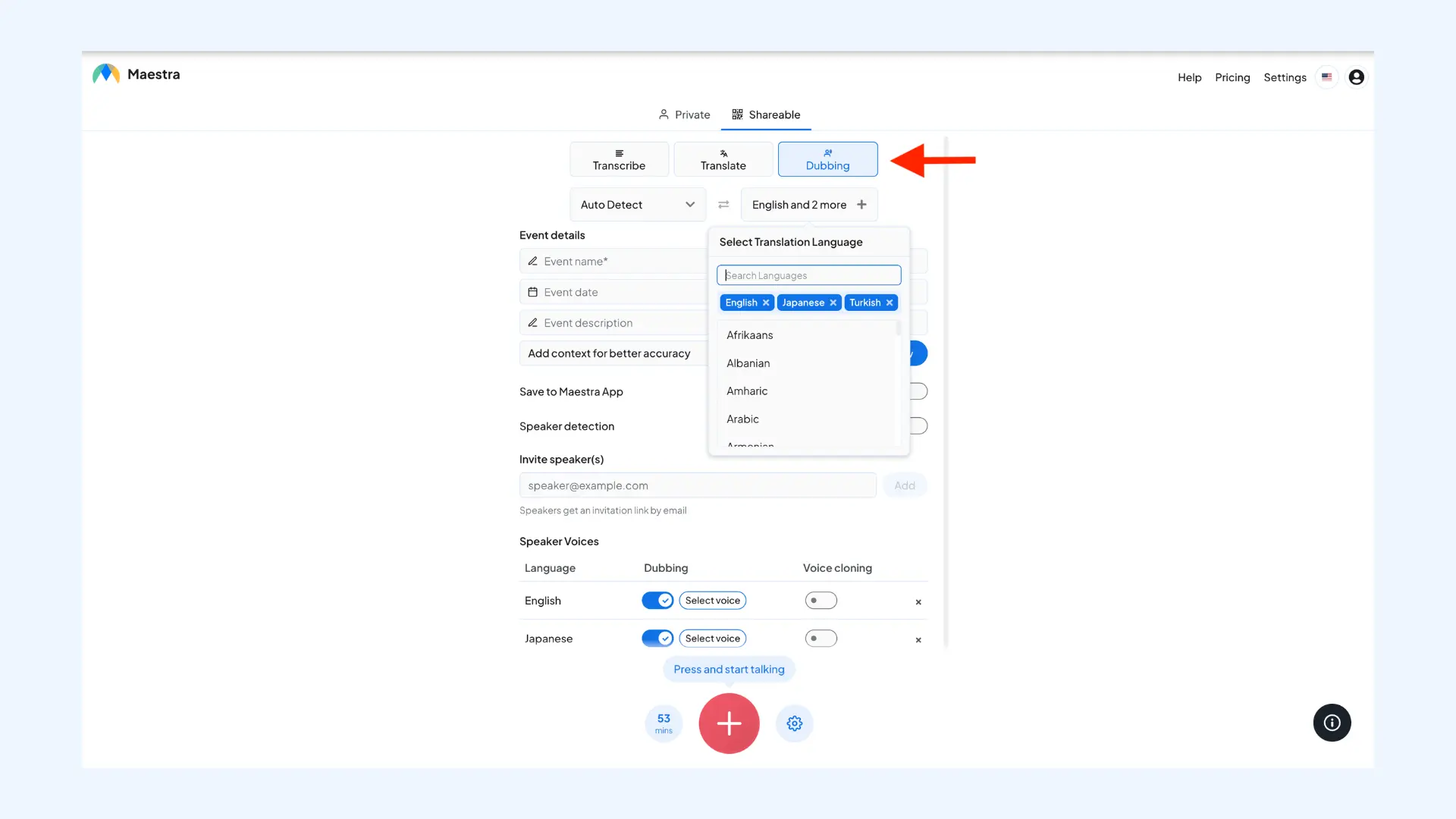
- At the bottom, select an AI voice for each target language, or choose to clone the speaker’s voice for a more natural and consistent output.
- Add your event details, including event name, date, time, and description.
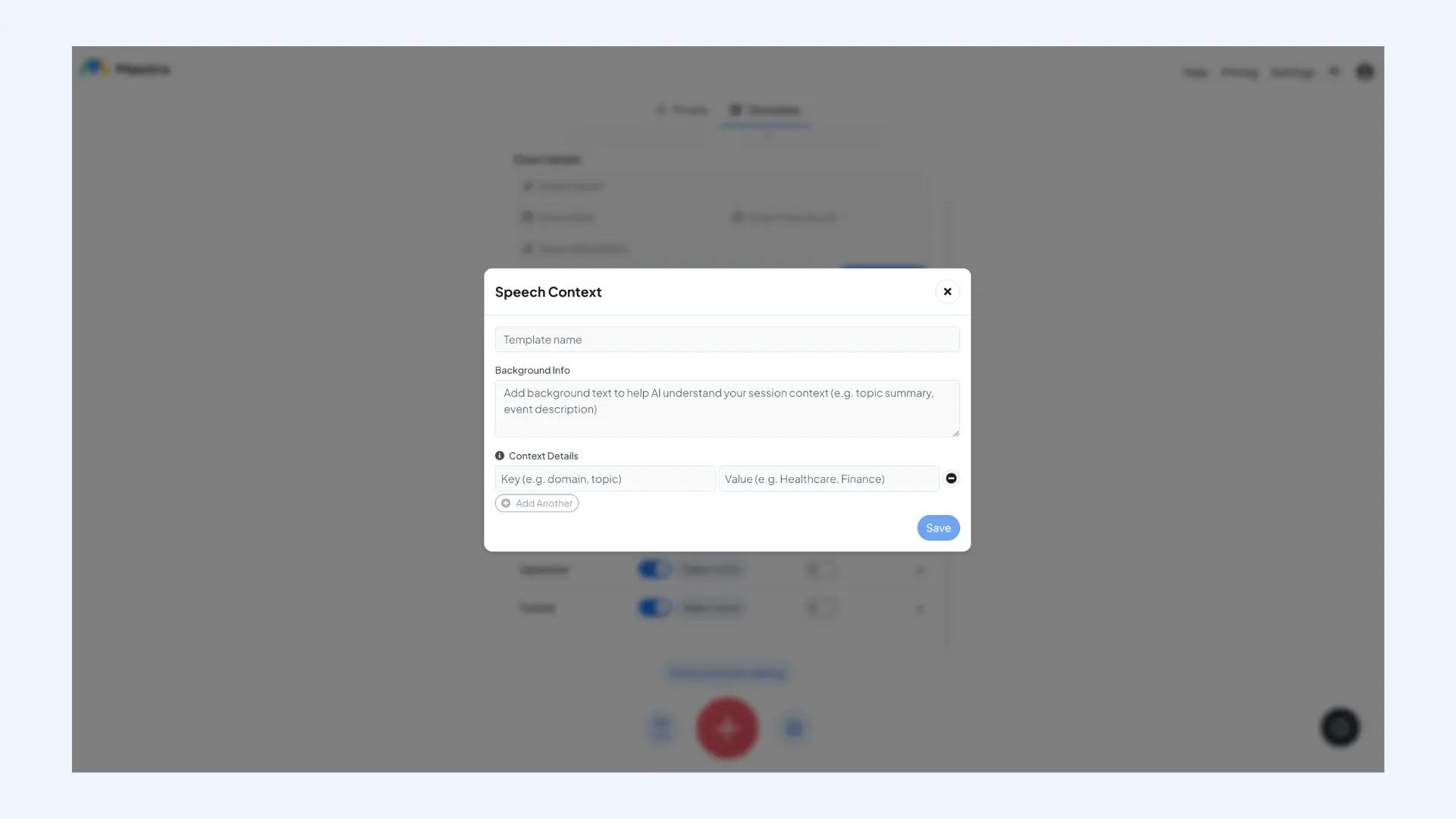
- If needed, you can also add context to improve translation accuracy. You can include background information such as a topic summary, event details, or domain-specific terminology to help the AI better understand your session.
- Toggle on Save to Maestra app to access the session transcript later for documentation, editing, and repurposing.
- Toggle on Speaker detection to automatically identify and separate different speakers during the session.
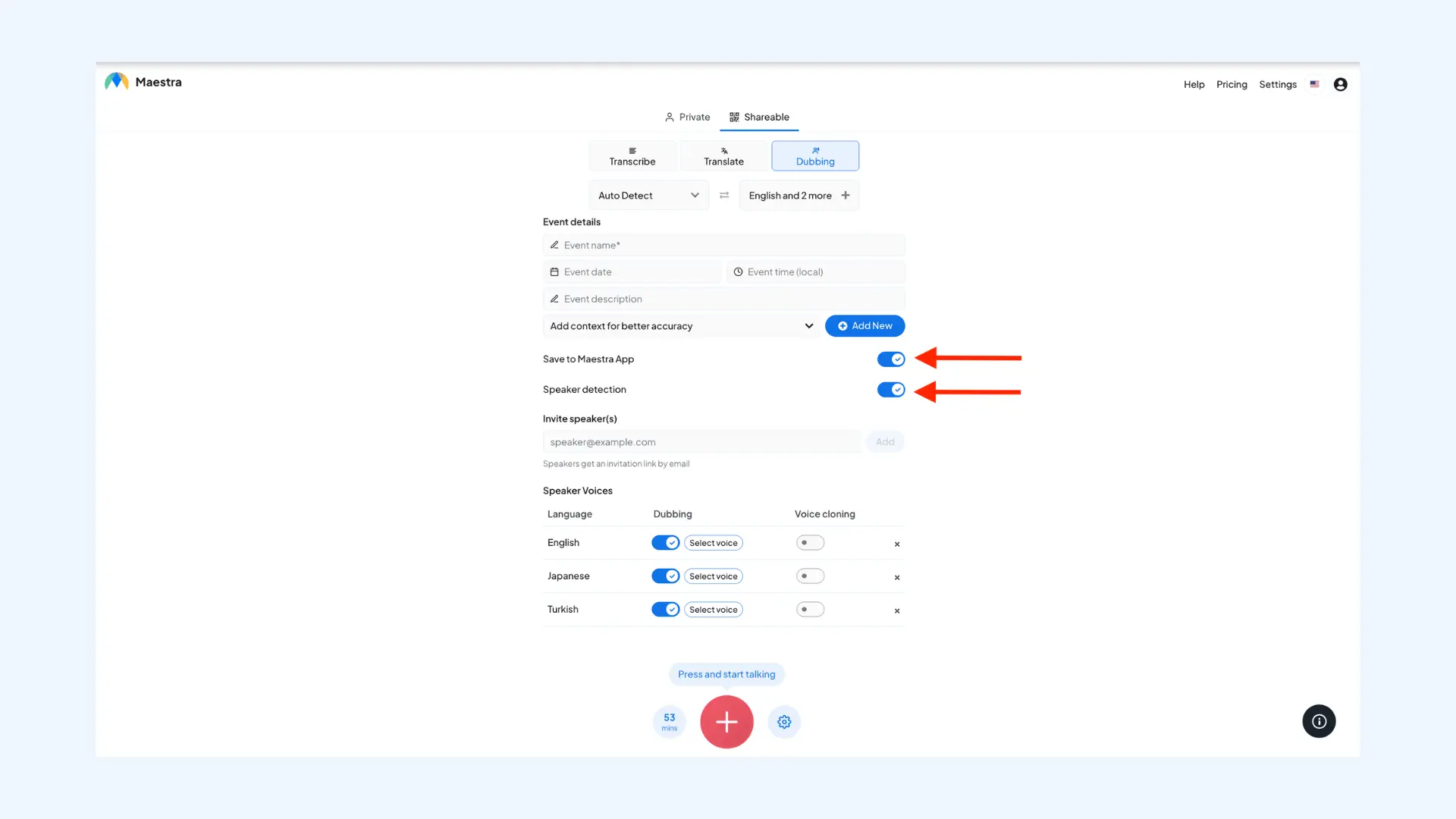
- To invite speakers, enter their email addresses to send a join link for the session.
- When everything is set up, click the red plus button. A unique QR code and shareable join link will appear. Review your session information and click Start Session.
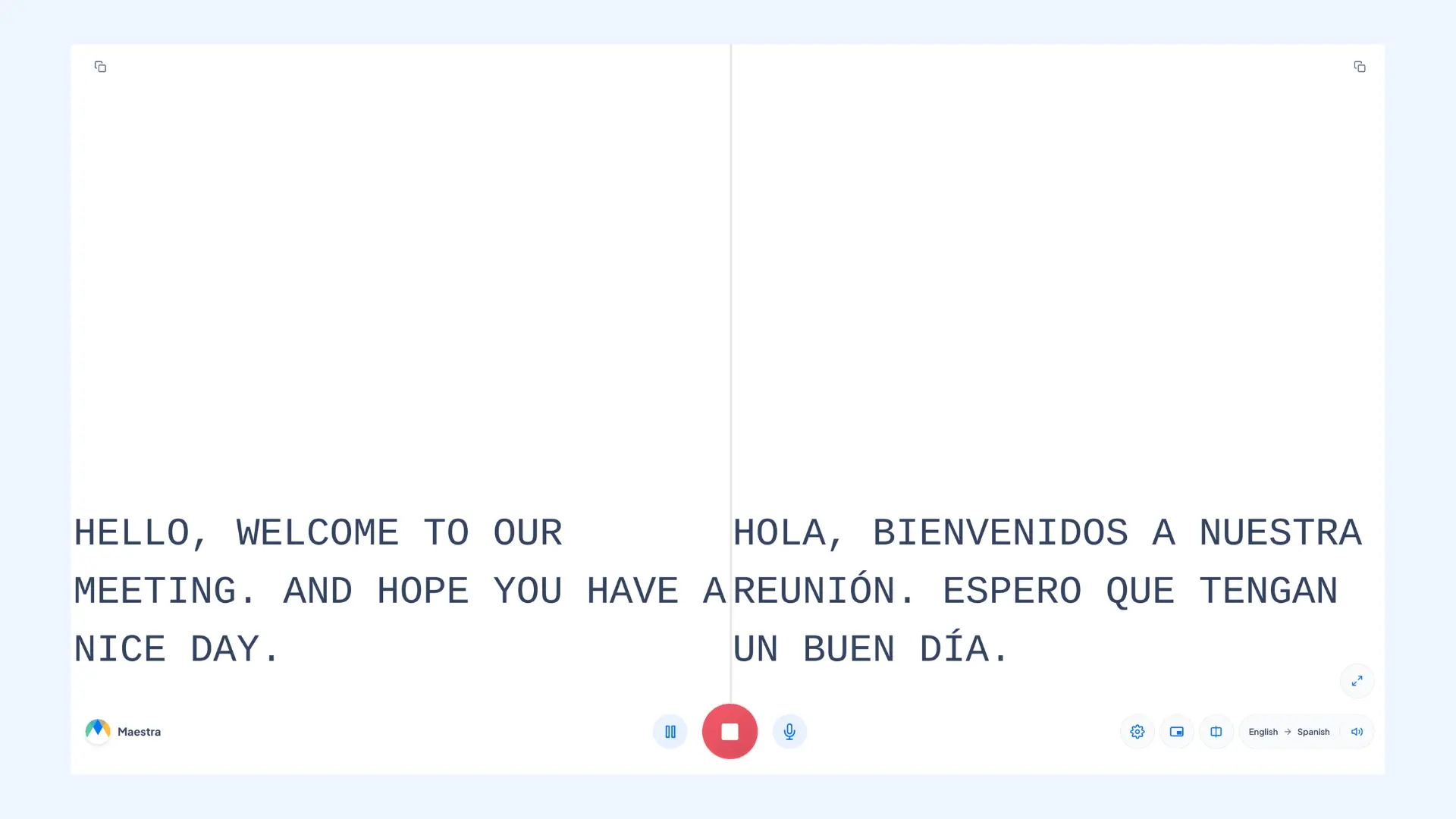
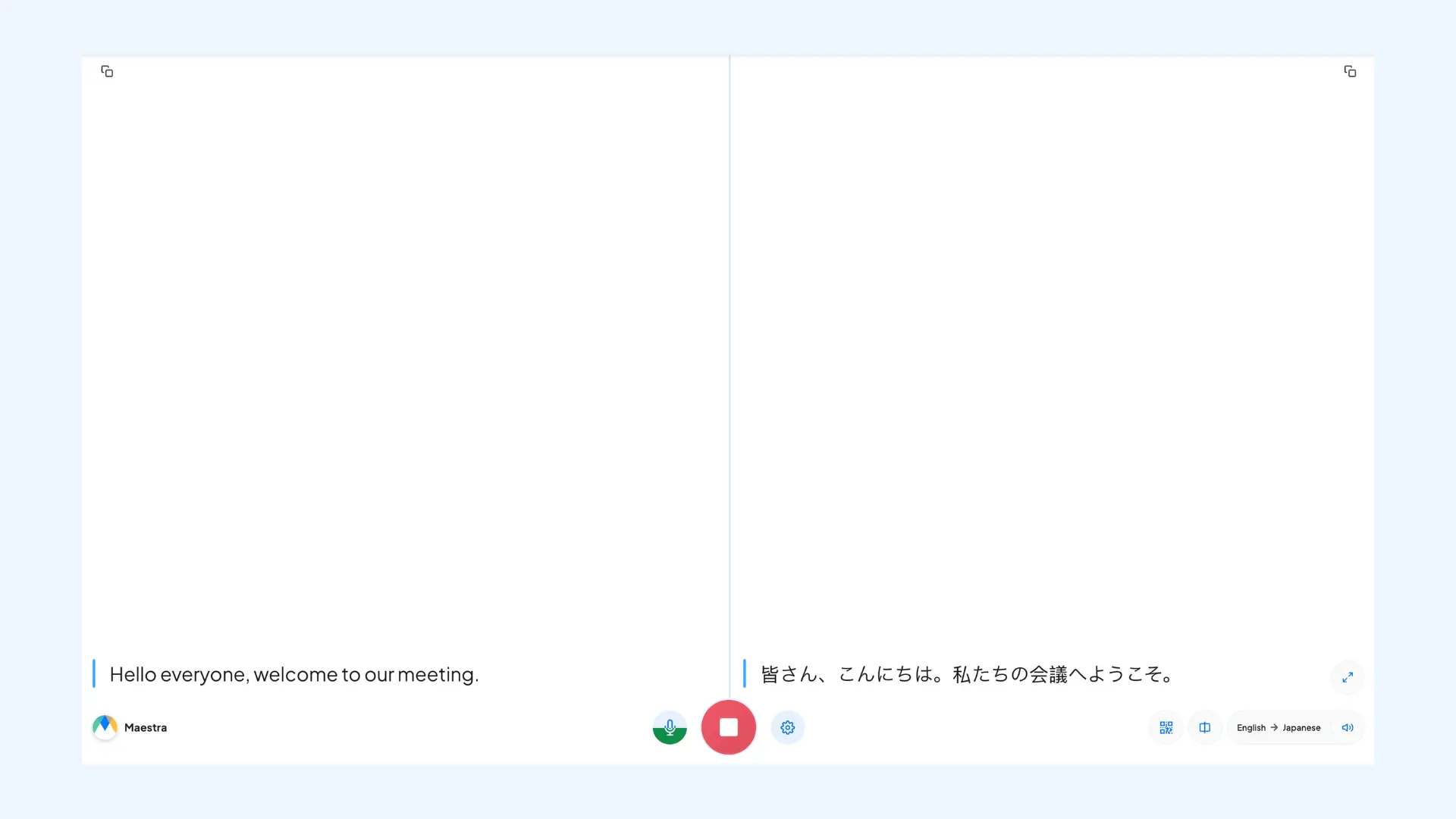
- Start speaking. A split-screen interface will appear, with the source transcript on the left and translated captions on the right. The translated audio will also play in real time as you speak.
⭐ If the split screen view doesn't appear: Click the language button at the bottom right (showing the source language), then select the target language to open the split-screen view.
- When the session ends, click the red microphone icon to stop the session. You can then save the transcript to your Maestra dashboard (if you haven't already enabled saving to app) or download the transcript as a TXT or DOCX file.
Further settings, accessed via the main page, allow you to customize and extend the functionality of the real-time translator:
- Caption customization: You can adjust the appearance of live captions by changing elements like font style and size, color, alignment, and speaker labels to improve readability and match your preferences.
- Integrations: You can connect the tool with platforms like Zoom, Microsoft Teams, vMix, and OBS, making it possible to use real-time speech translation in meetings, webinars, broadcasts, and live streams without changing your existing setup.
- Custom glossary and word replacements: You can create a custom dictionary by adding preferred terms, brand names, or industry-specific vocabulary, ensuring more consistent and accurate translations throughout your sessions.
Real-Time Online Voice Translation: Google Meet vs. Maestra
| Feature | Google Meet | Maestra |
| Language Support | 5 languages generally available (English ↔ Spanish, French, German, Portuguese, Italian); 70+ languages and 2,000+ combinations announced via Gemini 3.5 Live Translate, in private preview as of mid-2026 | 125+ languages supported |
| Platform Support | Built directly into and only works within Google Meet | Can integrate with Zoom, Microsoft Teams, OBS, and vMix |
| Voice Cloning | ✅ | ✅ |
| Multilingual Session Support | Single pair in the widely available version; 2,000+ combinations in private preview | ✅ |
| Accessibility & Pricing | Available to users with Google AI Pro/Ultra plans and eligible Google Workspace tiers | Offers Premium, Business, and Business Plus plans, plus custom enterprise pricing |
| Free Trial | ❌ | ✅ |
Top Use Cases for Real-Time Speech Translation
If you're wondering where real-time speech translation actually makes a difference, these are the situations where I've seen tools like Maestra's talking translator work best. The value shows up most when people from different language backgrounds need to communicate live without slowing down the conversation.
To significantly advance S2ST, we created a scalable data acquisition pipeline and developed an end-to-end model that provides direct, real-time language translation with just a two-second delay.
Multilingual Meetings
In international meetings, language differences can easily slow the discussion down. Real-time translation helps teams stay focused on the conversation instead of constantly switching languages or relying on summaries afterward. Participants can follow the conversation in their preferred language through audio or captions while the meeting continues naturally.
Global Webinars and Virtual Events
When running webinars or online events for an international audience, making the content accessible to everyone can be difficult. Real-time translation helps presenters reach participants who may not speak the event’s primary language. This is especially useful for live webinar translation, where attendees can join through shareable links or email invitations and listen to translated audio directly from their own devices.

Online Education and E-Learning
For educators and course creators working with international learners, language barriers can limit participation. Real-time translation makes it easier for students to follow lectures and discussions without waiting for translated materials later. In these cases, education translation in real time can help deliver content more clearly across different language groups.
Live Events and Streams
Live conferences and panel discussions often attract audiences from different regions. In these situations, a real-time translator can make the occasion more accessible without requiring human interpreters for every session, which can reduce overall costs. The same approach can also be used for live streams, allowing creators to expand their reach and connect with audiences who speak different languages.
Enterprise Training and Internal Comms
Large organizations often run training sessions or internal updates for employees across multiple countries. In these cases, real-time translation is often used to make communication more accessible. For companies operating internationally, training translation can help ensure consistency across teams.
Final Verdict
From what I've tested, Google Meet's real-time speech translation works best in simple, controlled scenarios. It's convenient, built-in, and easy to enable, but the broadly available version doesn't yet cover the needs of teams working across multiple languages or platforms. The single language pair limitation and restricted language support remain the biggest constraints for most users today. If you need something more flexible right now, Maestra's live speech translator may be the better option.
This is clearly evolving fast. Google's new Gemini 3.5 Live Translate model promises a major leap, with 70+ languages and thousands of language combinations in a single meeting, but it's still in private preview, with no confirmed rollout date, pricing, or tier requirements. Even as it becomes widely available, there will still be a distinction between native meeting features tied to one platform and dedicated translation tools that work across Zoom, Teams, webinars, and live streams.
FAQs on Google Meet Real-Time Speech Translation
Does Google Meet support real-time speech translation?
Yes, Google Meet supports real-time speech translation. It automatically dubs a speaker's voice into another language while preserving their original tone and pitch.
As of mid-2026, the feature is generally available for premium subscribers and supports bidirectional translation between English and five other languages, with a major expansion to 70+ languages via Google's Gemini 3.5 Live Translate model rolling out in private preview.
How does real-time speech translation work in Google Meet?
Google Meet translation uses a specialized speech-to-speech model built directly into the platform, so it requires no external bots or plugins. The generally available version transcribes, translates, and synthesizes audio in roughly two to three seconds. Google's newer Gemini 3.5 Live Translate model processes speech continuously as it streams, staying just a few seconds behind the speaker rather than waiting for each turn to finish.
Which languages are supported by Google Meet real-time speech translation?
As of mid-2026, the generally available Google Meet feature supports bidirectional translation between English and five major languages: Spanish, French, German, Portuguese, and Italian. Google's Gemini 3.5 Live Translate model, in private preview, expands this to 70+ languages and 2,000+ language combinations.
Please note that while many other languages are supported for text-based captions, the broadly available AI-dubbed voice translation currently focuses on that core group.
Can Google Meet live translate captions?
Yes, Google Meet can live translate captions. Users can view translated captions as on-screen text or combine them with real-time AI speech translation for a more immersive multilingual experience. While the widely available speech translation supports a limited set of major languages, translated captions are available in a much wider range, covering around 70 languages.
How accurate is Google Meet live translation?
Google Meet live translation is generally accurate for clear speech and common vocabulary. However, because the system translates speech in real time, it can produce more errors than translations generated from recorded audio or written text. Accuracy may also decrease when there is background noise, fast speech, or complex technical terminology.
Is Google Meet live translation available on mobile devices?
Google Meet live speech translation is currently available only on computers. Participants who join meetings from mobile devices cannot use the in-meeting feature yet, though Google has confirmed that support for Android and iOS apps is planned.
Note that the standalone Google Translate app now offers live translation on Android and iOS, but that is separate from the Google Meet feature.
Can Google Meet translate into multiple languages at the same time?
The generally available version supports only one language pair at a time, meaning all participants use the same translation combination during the meeting. Google's Gemini 3.5 Live Translate upgrade introduces 2,000+ language combinations in a single meeting, but it is currently limited to private preview.
For multiple source and target languages available today, tools like Maestra’s live voice translator with voice cloning allow participants to select different languages simultaneously.
Is Google Meet translation better than Zoom AI translation?
Both now offer spoken translation, so it depends on your needs. Google Meet translates a speaker's voice into another language in real time while trying to keep their original tone and pitch. Zoom translation recently added a similar feature called Voice Translator, which lets people speak in one language while others hear it in their own, though as of mid-2026 it's still in beta, covers only five languages (English, Chinese, French, Japanese, and Spanish), and is limited to paid US-based accounts.